
Key takeaways
- Compare the best smart smoke and CO detectors with app alerts for away-from-home, with voice warnings, wireless interconnect, and long-life power compared.
What's inside
As an Amazon Associate I earn from qualifying purchases. This post may contain affiliate links at no extra cost to you.
A smoke alarm that only sounds inside the house does its job when someone is home to hear it. When the house is empty, the same alarm needs a second way to reach you, and that is exactly what best smart smoke and CO detectors with app alerts for away from home are built to do. These alarms combine a smoke sensor and a carbon monoxide sensor in one ceiling unit, then add a Wi-Fi or hub connection that sends a notification to your phone the moment either sensor trips. The local horn still sounds at full volume for anyone inside, while the phone alert covers the hours when the house is empty, the family is on holiday, or everyone is asleep in a far bedroom with the door closed.
The difference between a connected alarm and a conventional one is not the sensing. Both kinds carry a photoelectric or ionization smoke sensor and an electrochemical carbon monoxide sensor, and both are listed to UL 217 for smoke and UL 2034 for carbon monoxide. The difference is the path the warning takes after the sensor trips. A conventional alarm relies on sound alone. A connected alarm adds a radio, an app account, and a cloud or hub relay, so the warning travels to your phone wherever you are. That extra path matters most for carbon monoxide, which has no smell and no visible sign, and for slow smoldering fires that can fill a house with smoke long before flames are visible from outside.
Shopping for this category means sorting through a small field of genuinely connected alarms and a much larger field of alarms that sound connected but are not. Some battery alarms interconnect by radio frequency with other alarms in the same house yet never reach a phone. Some hardwired alarms carry a voice warning and a sealed battery yet have no Wi-Fi radio at all. Both kinds are useful in the right home, but neither one sends an alert to a phone in another city. The seven alarms in this guide all have a real remote-alert path: Wi-Fi to a phone app, a Z-Wave hub that relays alerts through a security app, or a base station that bridges the alarm to your home network. Each one is listed to UL 217 and UL 2034, each one covers smoke and carbon monoxide in a single unit, and each one keeps sounding locally even if the internet goes down.
Before choosing, think about the house the alarms will live in. A home with existing hardwired alarm wiring suits a hardwired connected alarm that drops onto the old mounting plate and draws power from the ceiling circuit. A home with no alarm wiring suits a battery alarm that mounts anywhere with two screws. A home already running a Z-Wave security hub suits a Z-Wave alarm that joins the hub instead of adding another Wi-Fi device. A home with an Alexa speaker in every room may suit an alarm with a built-in speaker, while a Google Home household may suit an alarm that appears in the same app as the thermostat and doorbell. The right pick is the one whose alert path matches the network you already run, whose power source matches the ceiling it will hang from, and whose voice warning your household can understand at three in the morning.
Quick verdict
If you want the most complete remote-alert package in a single alarm, start with the Google Nest Protect. Its split-spectrum smoke sensor watches for both fast flaming fires and slow smoldering fires, its electrochemical carbon monoxide sensor is rated for ten years, and its app shows the status of every alarm in the house with a spoken voice warning that names the room. If your home already has hardwired alarm boxes and you want the newest drop-in replacement for an aging Nest Protect, the First Alert SC5 Battery is the maker-designated successor, with Google Home integration and wireless interconnect for up to eighteen compatible alarms. If you run Apple HomeKit or want a ceiling speaker as well as an alarm, the First Alert Onelink Safe and Sound pairs a photoelectric smoke sensor with an electrochemical carbon monoxide sensor, an Alexa speaker, and a nightlight in one hardwired unit. For a Z-Wave security household, the First Alert ZCOMBO sends smoke and carbon monoxide alerts through Ring Alarm or SmartThings without adding another Wi-Fi device. For a hardwired home that wants Kidde app alerts plus a sealed ten-year backup battery, the Kidde P4010ACSCO-WF is the straightforward pick, and the X-Sense SC07-MR is the budget-friendly route to whole-house radio interconnect with app alerts once you add the X-Sense base station.
| Product | Key spec | Best for |
|---|---|---|
| Google Nest Protect (2nd Gen) | Split-spectrum smoke sensor; electrochemical CO sensor; Wi-Fi app alerts | Most complete remote-alert package |
| First Alert SC5 Battery (SMCO600NV) | Google Home; wireless interconnect up to 18 alarms; 6 CR123A batteries | Replacing a Nest Protect without rewiring |
| First Alert Onelink Safe & Sound (1039102) | Alexa speaker; HomeKit; hardwired with 10-year sealed backup | Apple households wanting a ceiling speaker |
| First Alert Onelink Smoke & CO Alarm Hardwired (1042135) | HomeKit; Wi-Fi; 10-year sealed lithium backup | Hardwired HomeKit homes |
| First Alert ZCOMBO Z-Wave Smoke & CO Alarm | Z-Wave Plus; works with Ring Alarm and SmartThings; 2 AA batteries | Z-Wave security households |
| Kidde P4010ACSCO-WF Smart Smoke + CO Alarm | Kidde app; hardwired with sealed 10-year backup; interconnect up to 24 | Hardwired Kidde homes |
| X-Sense SC07-MR Smart Smoke & CO Alarm | RF interconnect; app alerts via SBS50 base station; CR123A battery | Budget whole-house coverage with app alerts |
How we chose
We started from the keyword and worked outward. The phrase "app alerts for away from home" sets three hard requirements: the alarm must sense both smoke and carbon monoxide, it must have a real path to a phone when nobody is home, and it must keep working as an alarm when that path is down. Every product in this guide meets all three. The maker and retailer documentation for each model lists a Wi-Fi radio, a Z-Wave radio, or a base-station link alongside a phone app, and only alarms with that listing made the cut. Alarms with radio interconnect but no phone path were left out of this guide, even though several of them appear in our wider pool for other keywords in this family.
We then weighed the alert path itself. A Wi-Fi alarm sends alerts through its own app and needs a 2.4 GHz network, which is the band nearly every one of these alarms uses. A Z-Wave alarm needs a compatible hub, and its alerts arrive through the hub app, which is a strength in a Ring Alarm or SmartThings home and a dealbreaker in a home with no hub. A base-station alarm needs the station plugged in and connected before any phone alert can arrive, which adds a step and a separate purchase. We note each requirement in the product sections so you can match the alarm to the network you already have rather than buying into a new one by accident.
Power source came next. A hardwired alarm draws from the ceiling circuit and keeps a battery only as backup, which suits homes that already have alarm wiring and owners who dislike battery chores. A battery alarm mounts anywhere and suits homes with no wiring, but it asks for battery attention on a schedule the maker states. Sealed ten-year batteries remove that chore for the life of the alarm, while replaceable cells let you swap power without replacing the unit. We list the exact power arrangement for each alarm because it decides both the installation and the long-term routine.
We also weighed sensing, voice warnings, and interconnection. Photoelectric smoke sensing is the common choice across this group and suits smoldering fires, while split-spectrum sensing adds a second wavelength to separate cooking aerosols from real smoke. Voice warnings that name the hazard and the room are easier to act on in the dark than a bare horn, and we favor alarms that speak clearly. Interconnection matters because a fire or carbon monoxide event on one floor should wake every floor, and we record whether that link runs over house wiring, radio frequency, or Wi-Fi. Finally, listing: every alarm here is listed to UL 217 for smoke and UL 2034 for carbon monoxide, and those listings are described here rather than any claim about what an alarm can stop.
Google Nest Protect (2nd Gen)
The Nest Protect is the reference point for this whole category, and it earns that place through sensing and communication rather than through any single headline feature. The product page lists a split-spectrum smoke sensor that reads smoke at two wavelengths, which the maker describes as a way to tell fast flaming fires and slow smoldering fires apart from steam and cooking aerosols. The carbon monoxide side uses an electrochemical sensor rated to last up to ten years from the date of manufacture, and the alarm is listed to UL 217 and UL 2034. It comes in a battery version powered by six AA lithium cells and a wired version that runs on 120 volts with battery backup, so the same alarm fits a home with or without ceiling wiring. A small motion-activated Pathlight glows when you pass underneath at night, and the unit speaks its warnings aloud, naming the room where the hazard was sensed.
- Sensors: split-spectrum smoke sensor; electrochemical carbon monoxide sensor rated 10 years
- Power: battery version with 6 AA lithium cells; wired version on 120V with battery backup
- Connectivity: Wi-Fi; Nest app and Google Home app alerts; interconnects with other Nest Protect alarms
- Listings: UL 217 and UL 2034
- Sound: horn plus spoken voice alerts naming the room
- Size: 5.3 inches in diameter; 1.6 inches deep
- Service life: 10 years
The app is where the Nest Protect pulls ahead for away-from-home use. Each alarm reports its status to the Nest app and the Google Home app, so a phone shows every room at a glance, with battery level and sensor status alongside the alarm history. When smoke or carbon monoxide reaches the alarm threshold, the phone receives a push alert with the room name, and the alarm itself speaks the same information aloud. That pairing of a spoken local warning and a phone alert is the core of the away-from-home case: the people inside hear where the danger is, and the people outside learn about it at the same time. The split-spectrum sensor also helps with the everyday problem of nuisance alarms, since a detector that cries wolf over burnt toast teaches a household to ignore it, and the maker presents the two-wavelength design as its answer to that problem.
Pros: Split-spectrum sensing covers flaming and smoldering fires; spoken room-by-room voice alerts; app shows every alarm in the house; battery and wired versions fit any ceiling; ten-year service life.
Cons: No Apple HomeKit support; battery version needs six AA lithium cells; higher cost per unit than basic combo alarms when covering a whole house.
First Alert SC5 Battery (SMCO600NV)
The First Alert SC5 Battery is the alarm Google points Nest Protect owners toward now that the Nest Protect has been discontinued, and it is built to make that swap painless. The maker lists it as a direct replacement that fits the same ceiling mount, so a household replacing aging Nest Protect units can change them one at a time without new holes or new wiring. Inside, a photoelectric smoke sensor and an electrochemical carbon monoxide sensor handle detection, and the alarm reports to the Google Home app and the Resideo Connect app. Voice alerts name the hazard type and its location, and the wireless interconnect links up to eighteen compatible SC5 and Nest Protect alarms, so a mixed house of old and new units still sounds together.
- Sensors: photoelectric smoke; electrochemical carbon monoxide
- Power: 6 replaceable 3V CR123A lithium batteries
- Connectivity: Wi-Fi; Google Home and Resideo Connect app alerts; wireless interconnect up to 18 alarms
- Listings: UL 217 10th Edition and UL 2034
- Sound: 85 dB at 10 feet plus voice alerts naming hazard type and location
- Warranty: 10-year limited warranty
The SC5 Battery suits a home with no alarm wiring and a Google Home household. Six CR123A cells are an unusual power choice, and they cost more per cell than AA batteries, so keeping spares on hand matters. In exchange, the alarm needs no electrician, no ceiling box, and no wiring work, and it joins the same Google Home app as the Nest Protect units it replaces. The maker also lists steam-check logic aimed at cutting nuisance alarms from kitchens and showers, which is the kind of everyday refinement that decides whether a household trusts its alarms or starts resenting them. For a traveler, the practical point is simple: the phone alert arrives through Google Home, the voice alert names the room, and the whole set sounds together when any one unit trips.
Pros: Drop-in replacement for Nest Protect mounts; Google Home integration; wireless interconnect up to 18 alarms; voice alerts with location; 10-year limited warranty.
Cons: Six CR123A batteries are less common and costlier than AA cells; no Alexa or HomeKit support; no motion-activated night light.
First Alert Onelink Safe & Sound (1039102)
The Onelink Safe and Sound is three devices in one ceiling unit: a smoke alarm, a carbon monoxide alarm, and a premium speaker with Alexa built in. The hardwired unit carries a photoelectric smoke sensor and an electrochemical carbon monoxide sensor, and it is listed to UL 217 and UL 2034. It runs on 120-volt house wiring with a sealed ten-year lithium battery as backup, so a power cut does not silence it. The Onelink Home app sends remote notifications to a phone or tablet when smoke or carbon monoxide is detected, and the unit also works with Apple HomeKit, so the alarm appears in the Apple Home app alongside lights and locks. The built-in speaker plays music through AirPlay 2 and answers Alexa requests, and a nightlight with adjustable color and brightness is built into the same housing.
- Sensors: photoelectric smoke; electrochemical carbon monoxide
- Power: hardwired 120V with sealed 10-year lithium battery backup
- Connectivity: Wi-Fi; Onelink Home app alerts; Apple HomeKit; Alexa built in; AirPlay 2
- Listings: UL 217 and UL 2034
- Sound: 85 dB horn plus voice alerts naming type and location
- Extras: premium speaker; adjustable nightlight
- Size: 7 x 7 x 2 inches
The speaker is the reason to choose this alarm over its plainer sibling, and also the reason to think twice. In a hallway or living room ceiling, a speaker that fills the room with music is a genuine daily benefit, and Alexa voice control from the ceiling is convenient when your hands are full. In a bedroom, the same speaker may be unwanted, and the larger seven-inch square housing is more visible than a standard round alarm. For away-from-home alerts, the Onelink Home app sends the notification, and the app also shows battery level and lets you check alarm status, so a low battery is a phone message rather than a midnight chirp. The hardwired power suits homes replacing an existing wired alarm, since the included adapter plugs let it connect to the old harness without rewiring, and the ten-year sealed backup battery means the backup never needs a battery change during the life of the unit.
Pros: Alexa speaker and AirPlay 2 in the same ceiling unit; Apple HomeKit support; hardwired power with sealed ten-year backup; adjustable nightlight; remote app notifications.
Cons: Hardwired only, so it needs a ceiling box; larger housing than a standard alarm; speaker adds cost for buyers who only want detection.
First Alert Onelink Smoke & CO Alarm Hardwired (1042135)
The Onelink 1042135 is the plainer hardwired sibling of the Safe and Sound: the same connected smoke and carbon monoxide detection, the same HomeKit support, and the same app alerts, without the speaker. The maker lists a photoelectric smoke sensor and an electrochemical carbon monoxide sensor, Wi-Fi on a 2.4 GHz network, and the Onelink Home app for remote notifications, remote test, and remote silence. It runs on 120-volt house wiring with a ten-year sealed lithium battery as backup, and it interconnects with other BRK and First Alert hardwired alarms through adapter plugs included in the box. Voice alerts name the type of danger and the location, and the unit is listed to UL 217 and UL 2034.
- Sensors: photoelectric smoke; electrochemical carbon monoxide
- Power: hardwired AC with 10-year sealed lithium battery backup
- Connectivity: Wi-Fi 2.4 GHz; Onelink Home app alerts; Apple HomeKit; Alexa status checks
- Listings: UL 217 and UL 2034
- Sound: 85 dB horn plus voice alerts naming type and location
- Install: adapter plugs included; fits standard junction boxes
This is the right Onelink for a household that wants HomeKit and phone alerts in every room but does not want a speaker in every ceiling. The hardwired connection means the alarm never depends on batteries for its main power, and the sealed backup battery covers outages for the life of the unit. Because it interconnects with the wider BRK and First Alert hardwired range, a household can mix this connected alarm in the hallway with plainer hardwired alarms in bedrooms and still have the whole set sound together, with the Onelink unit sending the phone alert for the house. That mixed approach keeps the cost down while keeping the remote-alert benefit, which is a sensible way to cover a multi-level home. The trade-off is the ecosystem: the Onelink line is built around Apple HomeKit and the Onelink app, and households centered on Google Home or Alexa will find the SC5 or the Nest Protect a more natural fit.
Pros: HomeKit support with phone alerts; hardwired power with sealed ten-year backup; interconnects with BRK and First Alert hardwired alarms; adapter plugs included; voice location alerts.
Cons: Hardwired only; Onelink line is an older generation with limited new stock; no built-in speaker or nightlight.
First Alert ZCOMBO Z-Wave Smoke & CO Alarm
The ZCOMBO takes a different route to the phone: instead of Wi-Fi, it uses a Z-Wave Plus radio and talks to a hub. The alarm itself is a battery-powered combination unit with a photoelectric smoke sensor and an electrochemical carbon monoxide sensor, an 85 dB horn, and a single test and silence button. It runs on two AA batteries and mounts anywhere, with no wiring and no Wi-Fi password to enter. Pair it with a Ring Alarm base station or a SmartThings hub and its smoke and carbon monoxide events flow into the hub app, so the phone alert arrives through the security system the household already checks. The maker lists compliance with UL 217 and UL 2034, plus Z-Wave Plus certification with SmartStart QR pairing.
- Sensors: photoelectric smoke; electrochemical carbon monoxide
- Power: 2 AA batteries
- Connectivity: Z-Wave Plus; SmartStart QR pairing; works with Ring Alarm and SmartThings hubs
- Listings: UL 217 and UL 2034
- Sound: 85 dB horn; single test and silence button
- Warranty: 7-year limited warranty
The Z-Wave approach has a clear strength and a clear limit. The strength is that the alert rides on the hub the household already trusts, and hub automations can switch lights on or shut down HVAC equipment when the alarm trips, depending on how the hub is configured. Battery life also stretches further than Wi-Fi, because Z-Wave uses far less power, and the hub reports a low battery before the chirping starts. The limit is that without a hub, the ZCOMBO is simply a good basic combo alarm with no phone alerts at all, and it does not interconnect directly with other alarms the way a wired or radio-frequency set does; coordination between alarms happens through hub automations instead. For a Ring Alarm or SmartThings household that travels, that trade is worth making. For a home with no hub, a Wi-Fi alarm is the simpler path to the same phone alert.
Pros: Alerts flow through Ring Alarm or SmartThings; long battery life on two AA cells; no Wi-Fi needed; SmartStart QR pairing; tamper resistant.
Cons: Needs a compatible Z-Wave hub for any smart feature; no voice location alerts; no direct alarm-to-alarm interconnect.
Kidde P4010ACSCO-WF Smart Smoke + CO Alarm
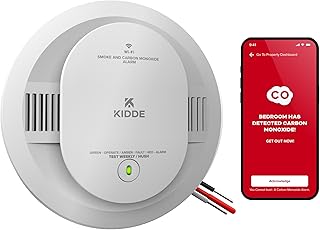
The Kidde P4010ACSCO-WF is the hardwired connected alarm for households that already run Kidde wiring. It carries a photoelectric smoke sensor and an electrochemical carbon monoxide sensor, runs on 120-volt house wiring, and keeps a sealed lithium battery as backup for ten years. Wi-Fi on a 2.4 GHz network connects it to the Kidde app through the Kidde HomeSafe feature, and the app sends real-time mobile alerts for smoke, carbon monoxide, low battery, and end of life. Voice alerts announce the hazard aloud, a glowing LED ring shows the current state at a glance, and the hardwired interconnect links up to twenty-four Kidde devices so the whole house sounds together. The maker lists UL 217 and UL 2034, and the CO response times follow the UL 2034 pattern: 70 parts per million in 60 to 240 minutes, 150 parts per million in 10 to 50 minutes, and 400 parts per million in 4 to 15 minutes.
- Sensors: photoelectric smoke; electrochemical carbon monoxide
- Power: hardwired 120V AC with sealed 10-year lithium battery backup
- Connectivity: Wi-Fi 2.4 GHz; Kidde app alerts; Google Assistant and Alexa status checks
- Interconnect: hardwired, up to 24 Kidde devices
- Listings: UL 217 and UL 2034
- Sound: 85 dB at 10 feet plus voice alerts
- Warranty: 10-year limited warranty
The practical advantage here is the whole-home relay. Adding one smart Kidde alarm to an existing hardwired Kidde set gives mobile alerts for the entire home, because the hardwired interconnect carries the alarm signal to the smart unit, which then sends the phone notification. That makes it a cost-effective upgrade for a house that already has Kidde wiring in every room: one smart unit at a central location, and the rest of the set stays as it is. The app also allows a Smart Hush from the phone when you are on the same Wi-Fi network, so a nuisance alarm from the kitchen can be silenced without climbing a ladder, and friends and family can be added to receive mobile alerts as well. The maker notes that mobile alert services are ancillary and depend on a stable Wi-Fi connection, which is worth remembering: the phone alert is a useful extra layer, and the local horn and the hardwired interconnect remain the primary warning.
Pros: One smart unit relays alerts for a whole hardwired Kidde set; sealed ten-year backup battery; Kidde app with phone hush; voice alerts and LED status ring; interconnect up to 24 devices.
Cons: Hardwired only; Wi-Fi features need AC power; app alerts depend on home Wi-Fi and internet.
X-Sense SC07-MR Smart Smoke & CO Alarm
The X-Sense SC07-MR is the value route to app alerts, with one condition to understand before buying: the phone alerts need the X-Sense base station, sold separately. The alarm itself is a battery unit with a photoelectric smoke sensor and an electrochemical carbon monoxide sensor, a replaceable CR123A battery rated for up to five years, and an 85 dB horn. Alarms interconnect over radio frequency with other X-Sense Link+ Pro alarms, so one detection sounds every unit in the house without any wiring. Add the SBS50 base station, connect it to a 2.4 GHz Wi-Fi network, and the X-Sense Home Security App adds instant phone notifications, remote test and silence, event history, and battery status for each alarm. The app can share control with up to twelve other users, and the product life is ten years.
- Sensors: photoelectric smoke; electrochemical carbon monoxide
- Power: replaceable CR123A battery rated up to 5 years
- Connectivity: RF interconnect with Link+ Pro alarms; app alerts via SBS50 base station; 2.4 GHz Wi-Fi through base station
- Listings: UL 217 and UL 2034
- Sound: 85 dB horn
- App: instant notifications; remote test and silence; event history; sharing with up to 12 users
- Warranty: 5-year warranty
The SC07-MR makes the most sense as a set. A single alarm plus a base station covers one room with phone alerts, but the value appears when three or four alarms share one base station and interconnect by radio, giving a whole house phone alerts and whole-house sounding for the cost of one station. The app warns from 100 parts per million of carbon monoxide, and it warns when the base station drops offline, which matters for a traveler who needs to know the link is alive. The trade-offs are the extra purchase, the five-year battery that needs replacing rather than a sealed ten-year cell, and an app ecosystem that reaches Home Assistant but not Alexa, Google Home, or Apple HomeKit. For a household that wants affordable whole-house coverage and is willing to add the base station, those are acceptable limits.
Pros: Affordable per-alarm cost in multi-packs; RF interconnect across floors without wiring; app with remote test, silence, and history; sharing with up to 12 users.
Cons: Phone alerts need the base station, sold separately; CR123A battery rated five years, not ten; no Alexa, Google Home, or HomeKit support.
Buying guide
Start with the alert path, because it decides everything else. If your home runs on Google Home, pick an alarm that appears in the Google Home app: the Nest Protect or the First Alert SC5. If your home runs on Apple HomeKit, pick the Onelink line. If your home runs a Ring Alarm or SmartThings hub, pick the ZCOMBO and let the hub carry the alert. If your home runs Kidde hardwired alarms, add a Kidde smart unit and let the wiring carry the alert to it. If none of those ecosystems fits, the X-Sense SC07-MR with its base station is a standalone route. Buying an alarm whose app you will never open is the most common mistake in this category, and it is easy to avoid by matching the alarm to the app already on your phone.
Next, match the power source to the ceiling. A hardwired alarm needs a junction box and a 120-volt circuit, and it suits a home replacing an existing wired alarm, because the new unit drops onto the old mounting plate with an adapter. A battery alarm needs only two screws and suits a home with no alarm wiring, a rental where wiring changes are not allowed, or a room far from any ceiling box. Sealed ten-year batteries remove battery chores for the life of the alarm, while replaceable cells let you swap power without replacing the unit. Check the maker-stated battery life for the exact model, and remember that Wi-Fi alarms draw more power than Z-Wave or radio-frequency alarms, so their battery routines differ.
Count the rooms before you count the cost. A smoke and carbon monoxide alarm belongs on every level of the home, inside each bedroom, and outside each sleeping area, following the maker placement guidance and local code. A single smart alarm in the hallway does not cover a bedroom with the door closed, and a single alarm on the ground floor does not cover a basement with a fuel-burning appliance. Whole-house coverage usually means four to six units, so compare the cost of the full set rather than the cost of one unit. Mixed sets are often the smartest buy: one or two connected alarms in central locations, plus interconnected non-connected alarms in bedrooms, so the whole house sounds together and the connected units send the phone alert.
Check interconnection before you buy. Hardwired alarms interconnect through the house wiring, and the maker lists how many devices can join one network; Kidde lists up to twenty-four devices for its hardwired range, with a limit on initiating devices under NFPA 72. Radio-frequency alarms interconnect without wiring, and the maker lists the maximum as well: up to sixteen for the First Alert SCO500B line, up to twenty-four for the X-Sense Link+ range, and up to eighteen for the SC5 wireless link. Wi-Fi alarms may interconnect through the app or through a proprietary link, and the exact behavior varies by brand, so read the maker page for the model you are buying rather than assuming any two smart alarms will link. Alarms from different brands generally do not interconnect, so a whole-house set should stay within one brand family.
Read the listing and the placement guidance. Every alarm in this guide is listed to UL 217 for smoke and UL 2034 for carbon monoxide, and those listings are the baseline for a residential alarm. The maker user guide also gives placement rules: alarms belong on the ceiling or high on a wall, away from kitchens and bathrooms where steam and cooking aerosols cause nuisance alarms, and carbon monoxide alarms belong on every level with fuel-burning appliances and outside sleeping areas. Follow the maker instructions and local code for placement, and follow the maker guidance on replacement: most alarms in this guide carry a ten-year service life, after which the unit should be replaced even if it still sounds during a button test.
Plan for the network going down. A phone alert depends on power, Wi-Fi, internet, and the app account, and any one of those can fail. That is why every alarm here keeps a local horn and a local voice warning that work without the network, and why hardwired interconnect keeps sounding the whole house during an internet outage. Keep the local alarm as the primary warning and the phone alert as the extra layer it is. Add family members to the app so more than one phone receives the alert, and check the app monthly to confirm each alarm still reports its status. A connected alarm that has silently dropped off the network is worse than a plain alarm, because it invites a false sense of coverage.
Finally, think about the end of the alarm life. Smoke and carbon monoxide sensors age, and the maker states a service life for each model, usually ten years from the date of manufacture. Write the replacement date on the alarm or in the app when you install it, and set a calendar reminder for the month it expires. When the time comes, replace the whole set together if you can, because a mixed set of old and new alarms may not interconnect, and a single new alarm in a house of expired units leaves the rest of the house covered only by sound. The SC5 exists precisely for that moment: a drop-in replacement that fits the old mount and joins the old app, so the upgrade is a ladder job rather than a rewiring job.
FAQ
Do smart smoke and CO detectors send alerts when I am away from home?
Yes, when the alarm has a working remote-alert path and the home network is up. A Wi-Fi alarm sends a push notification through its app, a Z-Wave alarm sends the alert through its hub app, and a base-station alarm sends it through the station. The alert depends on power, Wi-Fi, and internet at the house, so the local horn remains the primary warning and the phone alert is an extra layer.
What happens to app alerts during a power cut or internet outage?
The local alarm keeps working on its backup battery, and hardwired or radio-frequency interconnect keeps sounding the whole house. Phone alerts pause until power and internet return, because the Wi-Fi radio and the cloud relay need both. Some alarms, such as the Kidde smart models, state plainly that Wi-Fi features do not function without AC power. Keep the app check as a monthly habit so a dropped connection is noticed before an emergency.
Can I mix smart alarms with my existing hardwired alarms?
Often yes, within the same brand family. The Kidde smart alarms interconnect with existing Kidde hardwired alarms, so one smart unit can relay mobile alerts for the whole set. The First Alert SC5 wirelessly interconnects with Nest Protect alarms, and the Onelink 1042135 interconnects with BRK and First Alert hardwired alarms through adapter plugs. Alarms from different brands generally do not interconnect, so check the maker compatibility list for the exact models before mixing.
How many smart alarms does a house need?
The maker guidance and local code usually call for an alarm on every level, inside each bedroom, and outside each sleeping area. For most homes that means four to six units. You do not need every unit to be smart: one or two connected alarms in central locations, plus interconnected alarms elsewhere, gives whole-house sounding and phone alerts at a lower cost than making every unit connected.
Are battery smart alarms reliable for a vacation home?
A battery smart alarm works in a vacation home, but the battery routine matters more there because nobody is around to hear a low-battery chirp. A sealed ten-year battery removes that chore for the life of the alarm, and an app that reports battery level lets you check from afar. A hardwired alarm with a sealed backup battery is the lowest-maintenance choice for a home that sits empty for weeks, provided the house keeps power and internet while you are away.
Do I need a hub for a smart smoke and CO detector?
It depends on the alarm. Wi-Fi alarms such as the Nest Protect, the SC5, and the Kidde smart models need no hub and connect straight to your router. The First Alert ZCOMBO needs a Z-Wave hub such as Ring Alarm or SmartThings, and without one it has no phone alerts. The X-Sense SC07-MR needs the X-Sense base station for app alerts, though its alarms interconnect by radio without it. Check the connectivity line for the exact model before buying.
Conclusion
The best smart smoke and CO detector with app alerts for away from home is the one whose alert path matches the network you already run and whose power source matches the ceiling it will hang from. The Google Nest Protect remains the most complete single package, with split-spectrum sensing, spoken room-by-room warnings, and an app that shows every alarm in the house. The First Alert SC5 Battery is the natural replacement for an aging Nest Protect, dropping onto the same mount and joining the same Google Home app. The Onelink Safe and Sound and the Onelink 1042135 serve Apple HomeKit households, with the Safe and Sound adding a speaker and a nightlight for rooms where those earn their keep. The First Alert ZCOMBO brings smoke and carbon monoxide alerts into a Ring Alarm or SmartThings home without adding another Wi-Fi device. The Kidde P4010ACSCO-WF turns one hardwired Kidde circuit into a whole-home alert system, and the X-Sense SC07-MR covers a whole house by radio once the base station is in place.
Whichever alarm you choose, cover every level, keep the alarms within one brand family so they interconnect, and check the app monthly to confirm each unit still reports. The phone alert is a useful extra layer for the hours the house is empty, and the local horn, the voice warning, and the interconnect remain the warning that matters most. Install the set, name each alarm by its room, add family members to the app, and write the replacement date on each unit so the coverage you buy today is still there in ten years.
Related guides
More from Amazon
Programs that pair well with the guide above. Offers and eligibility are set by Amazon and may change.
Collect the home and kitchen items you want in one registry that guests can shop from.
Create a wedding registrySet up recurring deliveries of everyday items on eligible products. Terms and savings are set by Amazon.
Explore Subscribe & SaveFree shipping on eligible items, Prime Video and more. Eligible new members can start with a free trial.
Start a Prime free trialAudiobooks and podcasts to listen to on the go. Eligible new members can start with a free trial.
Try Audible freeAs an Amazon Associate we earn from qualifying purchases.
More ways to save on your next project
Programs that pair well with the guide above. Offers and eligibility are set by Amazon and may change.
A free business account with business pricing and bulk-buying tools for work, shop or home office.
Create a business accountFast, free shipping on eligible items, plus Prime Video and more. Eligible new members can start with a free trial.
Start a Prime free trialAudiobooks and podcasts for the commute, the garage or the kitchen. Eligible new members can start with a free trial.
Try Audible freeA dedicated Amazon storefront for low-price finds. Offers and eligibility are set by Amazon.
Browse Amazon HaulAs an Amazon Associate we earn from qualifying purchases. Using these links costs you nothing extra.




Write Your Review
No reviews yet. Be the first to share your experience!