
Key takeaways
- Wireless interconnected smart smoke and CO alarms compared on network size, range, app alerts and voice location, so one alarm sounding wakes the whole house.
As an Amazon Associate I earn from qualifying purchases. This post may contain affiliate links at no extra cost to you.
A single alarm sounding in a closed basement rarely wakes anyone on the second floor. That gap is what the best smart smoke and co detectors with interconnected wireless alarm networks exist to close: when one unit senses smoke or carbon monoxide, every linked unit in the home sounds at once, and the alert reaches bedrooms, nurseries and phones together. Wireless links make the system practical in finished homes where running an interconnect wire between ceilings is not an option, and renters and renovators can build the network with screws and batteries alone.
The seven systems below build their networks differently. X-Sense and First Alert run dedicated radio links between alarms with generous device ceilings, Kidde's Ring model folds the network into a mainstream app, and Google's Protect units mix wired and battery models on one wireless web. Network size, radio range, voice location and app behavior are the details that separate them.
The case for the network is arithmetic as much as fear. Sound loses strength through every closed door, and a siren two floors away can arrive at a pillow quieter than a television in the next room. An interconnected system removes the distance from the equation: the alarm beside the bed sounds at full volume for a furnace-room event, and the household's response starts from the first second rather than after someone investigates a muffled noise. That is why fire safety guidance has pushed interconnect for years, and why the wireless version of it matters for the millions of homes built before interconnect wiring became standard.
Quick verdict
The X-Sense XP0A-MR system is the strongest all-round network here: up to 24 linked units, voice alerts that name the room, a CO readout on the alarm itself and app alerts through its base station. The First Alert SC5 Battery leads for app-first households, pairing an 18-alarm network with direct Wi-Fi and voice location. The SC07-W takes the opposite route, a sealed ten-year battery and a 24-unit radio network with no app or hub at all, which suits owners who want the network and nothing else. Nest Protect Battery remains the most polished voice experience, while the Kidde Ring battery model fits homes already living in the Ring app.
Comparison table
| Product | Key spec | Best for |
|---|---|---|
| First Alert SC5 Battery Smart Smoke & CO Alarm (SMCO600NV) | Wireless link up to 18 alarms, direct Wi-Fi | App-first households |
| First Alert Onelink Battery Wi-Fi Smoke & CO Alarm (DC10-500) | Sealed 10-year battery, HomeKit | Apple HomeKit homes |
| X-Sense XP0A-MR Smart Smoke & CO Alarm with SBS50 Base Station | Link+ network up to 24 units, CO display | Largest radio networks |
| X-Sense SC07-W Wireless Interconnected Smoke & CO Alarm | Sealed 10-year battery, 820 ft radio range | No-app simplicity |
| First Alert SCO500B | 915 MHz mesh up to 16 units, voice locations | Mesh voice alerts |
| Kidde Smart Smoke & CO Alarm with Ring (Battery) RGCUDR-RW | Wire-free interconnect, Ring app | Ring households |
| Google Nest Protect (Battery) S3000BWES | Wireless link up to 12 Protects, voice alerts | Spoken room names |
How we chose
Interconnection was the entry ticket: a model only qualified if its alarms form a network where one unit sounding triggers the rest, without a wired link between ceilings. Dedicated radio networks, mesh links and Wi-Fi-coordinated systems all counted, and the maker's stated device ceiling and radio range were recorded for each. App-only alarms with no alarm-to-alarm link were excluded, however polished their notifications.
Beyond the network, the comparison weighed what the network carries. Voice alerts that name the room turn a houseful of sirens into directions. App alerts extend the network to phones for owners away from home. Battery design decides upkeep: sealed ten-year cells, replaceable lithium cells and AA designs all appear. Standards listings such as UL 217 and UL 2034 were noted where the maker publishes them, and each finalist was matched to a distinct household pattern, from a no-hub purist install to a fully app-managed home.
First Alert SC5 Battery Smart Smoke & CO Alarm (SMCO600NV)
- Power: 6 replaceable 3V CR123A batteries
- Sensing: photoelectric smoke sensor plus electrochemical CO sensor
- Network: wireless interconnect up to 18 SC5 and Nest Protect alarms
- Smart features: direct Wi-Fi, Resideo Connect app alerts, voice location alerts
- Listings: UL 217 10th Edition, end-of-life warning, 85 dB siren
The SC5 Battery is unusual in carrying two radios with two jobs: Wi-Fi talks to the Resideo Connect app, while the wireless interconnect links up to 18 alarms, including Nest Protect units, into one sounding network. Voice alerts name the room in danger, so the network tells the household where to go, not just that something is wrong somewhere.
Six replaceable CR123A cells power the unit, a middle path between sealed designs and AA models: the cells last far longer than AAs but can still be swapped at end of life rather than replacing the alarm. The photoelectric sensor and tenth-edition UL 217 listing reflect the newest standard in this roundup. The main consideration is price per unit when a whole house needs six or eight alarms, and the app experience runs through Resideo's ecosystem.
Pros: Two-radio design links 18 alarms and phones at once; voice location; newest UL 217 edition here
Cons: Premium per-unit cost across a whole house; CR123A cells are less common than AA
First Alert Onelink Battery Wi-Fi Smoke & CO Alarm (DC10-500)
- Power: 10-year sealed lithium battery, non-replaceable
- Sensing: photoelectric smoke sensor plus electrochemical CO sensor
- Network: wireless interconnect between Onelink alarms
- Smart features: Wi-Fi, Apple HomeKit, Onelink Home app alerts, voice alerts naming danger and location
- Life: 10-year alarm life
The Onelink battery model is the set-and-forget entry in the First Alert family. Its sealed lithium cell is rated for the alarm's full ten-year life, so the network never drops a node to a dead battery someone forgot. Voice alerts name both the hazard and the room, and Apple HomeKit support makes it the natural pick for households whose lights, locks and cameras already answer to Apple Home.
The Onelink Home app handles alerts and status, and the wireless interconnect means one Onelink sounding raises the rest. The boundaries are clear: the network speaks Onelink, so it will not rally alarms from other brands, and when the decade ends the whole unit is replaced. Buyers building a mixed-brand house should look at the SC5 above; buyers standardizing on Onelink get a decade of quiet upkeep.
Pros: Ten-year sealed battery means zero battery chores; HomeKit support; spoken danger and location
Cons: Network limited to Onelink alarms; full replacement at end of life
X-Sense XP0A-MR Smart Smoke & CO Alarm with SBS50 Base Station
- Power: replaceable CR123A battery, up to 5 years per cell
- Sensing: photoelectric smoke sensor plus electrochemical CO sensor
- Network: wireless interconnect up to 24 Link+ units through the SBS50 base station on 2.4 GHz Wi-Fi
- Smart features: X-Sense Home Security app alerts, voice alerts with location, LCD showing CO concentration
- Life: 10-year sensor life, 85 dB siren
X-Sense builds the biggest network in this roundup: 24 Link+ units can join one system, enough for large homes, duplexes and small multi-unit buildings. The SBS50 base station bridges the alarms to Wi-Fi and the X-Sense app, so the radio network stays dedicated to alarm traffic while the base handles phone alerts, a division of labor that keeps individual alarms simple and battery-friendly.
The alarm itself carries an LCD that shows the carbon monoxide concentration in the air, a detail few rivals offer and one that helps a household judge whether a CO event is rising or clearing. Voice alerts name the location. The trade-offs: the base station is one more device to place and power, and the replaceable CR123A cells run up to five years, so a mid-life battery round is part of ownership.
Placement of that base station is the one design decision the system asks for: it wants a central spot with decent Wi-Fi, within comfortable radio reach of the farthest alarm, and near an outlet it can occupy permanently. A hallway console or a living-room shelf usually satisfies all three. Once placed, it also becomes the network's narrator, the point where alarm events turn into phone notifications, so a home with a weak router corner should solve that corner first rather than blaming the alarms.
Pros: 24-unit ceiling leads the group; CO concentration shown on the alarm; dedicated alarm radio plus app bridge
Cons: Base station required for app features; batteries need a mid-life swap
X-Sense SC07-W Wireless Interconnected Smoke & CO Alarm
- Power: sealed 10-year lithium battery, non-replaceable
- Sensing: photoelectric smoke sensor plus electrochemical CO sensor
- Network: wireless interconnect up to 24 Link+ units, over 820 ft open-air radio range
- Display: LCD shows CO level from 30 to 999 ppm
- Listings: UL 217 and UL 2034; 85 dB at 10 ft; no app or hub
The SC07-W strips the smart alarm back to the network itself. There is no app, no hub and no account: the alarms talk to each other over a long-range radio link, and when one sounds, all sound. The stated open-air range beyond 800 feet shrinks through walls and floors, but it still gives big or spread-out homes more headroom than shorter-range rivals, and the 24-unit ceiling matches the largest here.
A sealed ten-year battery means the network needs no upkeep for its whole service life, and the LCD CO readout shows the actual concentration rather than a bare warning. What buyers give up is remote awareness: nothing reaches a phone, so a house standing empty gets sirens nobody hears. For occupied homes that value simplicity and distrust apps, this is the cleanest interconnected design in the group.
There is also a resilience argument for this design that app-linked rivals cannot match. The network has no router to reboot, no account to lock, no subscription to lapse and no cloud service whose retirement could strand the hardware. The alarms pair to each other and keep their own counsel for a decade. In a category where app platforms change ownership and features move behind paywalls, a radio link that answers only to its sibling alarms is a deliberate, defensible kind of smart.
Pros: Longest radio range and a 24-unit ceiling; sealed decade battery; CO level readout; no accounts or hubs
Cons: No phone alerts of any kind; whole unit replaced at end of life
First Alert SCO500B
- Power: 2 AA batteries
- Sensing: photoelectric smoke sensor plus electrochemical CO sensor
- Network: wireless interconnect over a 915 MHz mesh, up to 16 units
- Voice: spoken alerts with 11 pre-programmed locations, including Basement
- Listings: maker spec states compliance with UL 217 and UL 2034; 85 dB; 7-year life
The SCO500B is the veteran of this group, a mesh-network alarm that has linked homes for years without Wi-Fi. Its 915 MHz mesh lets units relay for one another, which helps signals cross larger floor plans, and the voice system speaks from 11 pre-programmed location names, so the basement alarm identifies itself in words rather than beeps.
Power comes from two AA batteries, the easiest cells in this roundup to replace, and there is no app to configure. The limits show its age: the service life runs seven years against the ten-year norm now common, there are no phone alerts, and availability has thinned as newer models take shelf space. Where it remains in stock, it suits owners who want a spoken, self-organizing network with zero internet involvement.
Pros: Mesh relay extends coverage; spoken locations; AA batteries are everywhere
Cons: Seven-year life trails the class; no app alerts; stock is thinning
Kidde Smart Smoke & CO Alarm with Ring (Battery) RGCUDR-RW

- Power: 2 AA replaceable batteries
- Sensing: photoelectric smoke sensor
- Network: wire-free interconnect, when one sounds, all sound
- Smart features: Wi-Fi to the Ring app with no hub required, optional Ring 24/7 Smoke & CO monitoring
- Alerts: real-time phone notifications
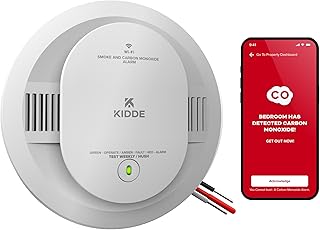
Kidde's battery model for Ring folds the alarm network into the app many homes already open daily. The wire-free interconnect rallies every unit when one sounds, and the Ring app delivers the alert with no hub purchase in between. Households that travel can add the optional professional monitoring service, turning a phone notification into a monitored event.
The AA battery choice keeps upkeep cheap and familiar. The considerations are ecosystem-shaped: the experience assumes a Ring household, monitoring is a paid subscription rather than a standard feature, and shoppers outside the Ring world will find the app story ordinary. Inside that world, this is the least-effort interconnected alarm to add.
Pros: No hub needed; lives in the Ring app; cheap AA upkeep; optional professional monitoring
Cons: Monitoring costs extra; best value stays inside the Ring ecosystem
Google Nest Protect (Battery) S3000BWES
- Power: 6 AA lithium batteries
- Sensing: Split-Spectrum smoke sensor plus 10-year electrochemical CO sensor
- Network: wireless interconnect up to 12 Protects
- Smart features: voice alerts with location, Wi-Fi app alerts and app hush
- Listings: UL 217 8th Edition and UL 2034 4th Edition; 85 dB
Nest Protect's network behavior is its charm: a calm voice names the room and the hazard, every Protect in the home repeats the message, and the siren follows if the event grows. The battery model mounts anywhere with no wiring at all, and wired Protects can join the same wireless network, so mixed installs behave as one system.
The Split-Spectrum sensor reads two light wavelengths to tell fast flames from slow smolder, and the app handles alerts, silence and status history. Two cautions apply. The network ceiling of 12 units is the lowest here, fine for most homes but a real limit for large ones, and Google has ended Protect production, leaving remaining retail stock. While it lasts, no rival speaks as clearly.
The battery model's mounting freedom is worth one more line in a network roundup: because nothing ties it to a ceiling circuit, a Protect can land in the rental flat, the finished attic or the hallway of a house whose wired points sit in the wrong rooms, and still join the same wireless conversation as the wired units downstairs. That flexibility is how many real networks end up covering the rooms the original builder never planned for.
Pros: Friendliest spoken alerts in the class; wired and battery units share one network; app hush
Cons: 12-unit ceiling is the lowest here; production has ended and stock is finite
Buying guide
Size the network first. Count every sleeping room, hallway, level and utility space that needs an alarm, then compare that count with each system's ceiling: 24 units for the X-Sense models, 18 for the SC5, 16 for the SCO500B and 12 for Nest Protect. Most single-family homes land between five and ten units, but finished basements, guest suites and workshops push counts up quickly.
Range deserves a skeptical read. Radio figures are quoted in open air, and walls, floors and metal ducting all shorten them; mesh systems and base-station designs cope better with awkward floor plans than simple point-to-point links. Decide next whether the network should reach your phone. App-linked systems add remote awareness for travelers and second homes, while radio-only systems like the SC07-W keep working with no internet, no account and nothing to configure.
Battery strategy shapes the decade ahead. Sealed ten-year units remove maintenance entirely and are replaced whole; replaceable cells cost less per year but demand a swap round mid-life. Voice location is worth prioritizing wherever bedrooms sit far from kitchens and furnaces, because a spoken room name directs a groggy household faster than a chorus of identical sirens. Finally, keep the whole network in one brand family: interconnect standards are brand-shaped, and mixed networks rarely rally as one.
Plan the pairing day as part of the purchase. Wireless networks form in a sequence, usually a hub, base or first alarm placed in learn mode while each additional unit joins, and the job goes fastest with every alarm on a table, labeled with its room name in pencil, before a single ladder comes out. Mount the unit nearest the home's center first so later units at the edges pair toward a strong signal, then walk the house pressing each alarm's test control to hear the whole network answer. Ten unhurried minutes at install is what separates a network that merely exists from one the household has actually heard working as a single system.
FAQ
How does wireless interconnect differ from a wired interconnect?
The result is the same, one alarm sounding raises all of them, but the path differs. Wired systems send the signal along a third wire in the ceiling circuit, while wireless systems use radio links between units. Wireless networks can be added to finished homes without opening walls, and they keep working in rooms where no interconnect wire was ever run.
Will alarms from different brands join one wireless network?
Generally no. Each brand's radio network is its own system, and units rally only their own family, with one notable exception here: the First Alert SC5 network also links Nest Protect alarms. Households mixing brands should expect each family to sound its own alarms and send its own app alerts.
What happens to the network if the Wi-Fi goes down?
The alarm-to-alarm radio links in these systems are independent of the home Wi-Fi, so local interconnect and sirens keep working during an internet outage. What pauses is the phone side: app alerts wait until the connection returns. Radio-only models such as the SC07-W are unaffected entirely.
How many interconnected alarms does a home need?
Coverage guidance calls for alarms inside every bedroom, outside each sleeping area and on every level, plus CO coverage near fuel-burning appliances. A typical two-story home lands around six to eight units, well inside every ceiling in this roundup except the largest homes against Nest Protect's 12-unit limit.
Do wireless interconnected alarms suit apartments and condos?
Yes, and they solve a specific apartment problem: building alarms cover corridors and shared spaces, but the inside of a unit is the resident's own responsibility in many leases. A battery wireless network mounts with screws, needs no wiring approval, and gives a multi-room flat the whole-home rally that single standalone alarms cannot. Sealed-battery models remove the maintenance question for the length of a typical tenancy, and the whole network can move with the resident at lease end.
Do interconnected alarms need professional installation?
No. Battery models mount with screws and pair through a button sequence or app flow, and most households finish a room in minutes. The planning step that matters is placement: follow the maker's spacing guidance, keep units away from kitchens' steam zones where the manual directs, and name each room in the app so voice and phone alerts identify the right space.
Conclusion
An interconnected wireless network turns scattered alarms into one household voice, and the right system depends on how that voice should reach you. X-Sense builds the largest and longest-range networks, First Alert pairs its network with direct Wi-Fi or HomeKit, Kidde folds the system into Ring, the SCO500B keeps a proven mesh speaking without the internet, and Nest Protect still talks the clearest. Count your rooms, pick one family, and let every alarm speak for all the others.
Related guides
More from Amazon
Programs that pair well with the guide above. Offers and eligibility are set by Amazon and may change.
Collect the home and kitchen items you want in one registry that guests can shop from.
Create a wedding registrySet up recurring deliveries of everyday items on eligible products. Terms and savings are set by Amazon.
Explore Subscribe & SaveFree shipping on eligible items, Prime Video and more. Eligible new members can start with a free trial.
Start a Prime free trialAudiobooks and podcasts to listen to on the go. Eligible new members can start with a free trial.
Try Audible freeAs an Amazon Associate we earn from qualifying purchases.
More ways to save on your next project
Programs that pair well with the guide above. Offers and eligibility are set by Amazon and may change.
A free business account with business pricing and bulk-buying tools for work, shop or home office.
Create a business accountFast, free shipping on eligible items, plus Prime Video and more. Eligible new members can start with a free trial.
Start a Prime free trialAudiobooks and podcasts for the commute, the garage or the kitchen. Eligible new members can start with a free trial.
Try Audible freeA dedicated Amazon storefront for low-price finds. Offers and eligibility are set by Amazon.
Browse Amazon HaulAs an Amazon Associate we earn from qualifying purchases. Using these links costs you nothing extra.



Write Your Review
No reviews yet. Be the first to share your experience!