
Key takeaways
- Compare the best smart smoke and CO detectors for basements with fuel burning appliances, with hardwired and battery alarms for furnace rooms compared here.
What's inside
As an Amazon Associate I earn from qualifying purchases. This post may contain affiliate links at no extra cost to you.
The basement is where a house keeps its combustion. The furnace, the boiler, and the gas water heater all burn fuel down there, and carbon monoxide is the invisible byproduct when that combustion goes wrong. It has no smell and no color, and it rises through the stairwell and the ductwork long before anyone upstairs notices a headache or a wave of dizziness. A smoke alarm alone does not cover that risk, because the danger in a basement with fuel-burning appliances is as much about the air as about fire. That is why best smart smoke and CO detectors for basements with fuel burning appliances is a search about placement as much as about product: the right alarm is a combination unit, on the right level, close enough to hear the furnace room and far enough from the appliance to read the air honestly.
The maker placement guidance is consistent across brands: carbon monoxide alarms belong on every level with fuel-burning appliances and outside sleeping areas, and the user guide for each model gives the exact distances from the appliance, the ceiling height, and the spots to avoid. An alarm mounted directly above a furnace reads the exhaust plume rather than the room air, and an alarm mounted in a damp corner near a laundry sink may suffer from humidity outside its operating range. Most combination alarms in this guide list an operating temperature of 40 to 100 degrees Fahrenheit and a humidity range up to 85 or 95 percent relative humidity, non-condensing, and a cold or damp basement should be checked against those numbers before the alarm goes up.
This guide covers seven combination alarms that suit a basement with fuel-burning appliances. All seven sense both smoke and carbon monoxide in one unit, all seven are listed to UL 217 and UL 2034, and all seven carry a maker-stated interconnect so a basement event sounds the bedrooms upstairs. The hardwired models suit a basement that already has alarm wiring or a junction box near the stairwell. The battery models suit a finished basement with no wiring, or a utility room where a new circuit is not practical. Several models carry a carbon monoxide display or peak level memory, which gives a number or a recorded event rather than a bare siren, and that information matters when a technician arrives to find the cause. Pick the alarm that matches the basement wiring, the humidity, and the distance to the furnace.
Quick verdict
If the basement has a furnace with a hardwired alarm circuit nearby, start with the Kidde KN-COSM-IBA. Its voice message system announces the hazard aloud, its peak level memory records carbon monoxide at 100 parts per million or higher, and its hardwired interconnect links up to twenty-four Kidde devices so the bedrooms upstairs sound with the basement. If the basement has no wiring and you want ten years without a battery change, the X-Sense SC07-W carries a sealed ten-year battery, radio interconnect for up to twenty-four units, and an LCD display that shows the carbon monoxide concentration from 30 to 999 parts per million. If the house runs on Google Home and the basement alarm should send phone alerts, the First Alert SC5 Hardwired drops onto existing wiring with a lithium backup and joins the Google Home app. If the basement is part of a Z-Wave security setup, the First Alert ZCOMBO sends its alerts through Ring Alarm or SmartThings on two AA batteries. If the basement doubles as a living room, the First Alert Onelink Safe and Sound adds a speaker and a nightlight to the same hardwired alarm.
| Product | Key spec | Best for |
|---|---|---|
| Kidde KN-COSM-IBA Hardwired Smoke & CO Alarm | Voice messages; peak level memory; interconnect up to 24 | Furnace rooms with Kidde wiring |
| X-Sense SC07-W Wireless Interconnected Smoke & CO Alarm | Sealed 10-year battery; CO display 30-999 ppm; RF up to 24 | Basements with no wiring |
| First Alert SC5 Hardwired (SMCO600NV-AC) | Google Home; hardwired interconnect up to 18; voice alerts | Google Home basements with wiring |
| First Alert Onelink Safe & Sound (1039102) | Alexa speaker; HomeKit; hardwired with 10-year sealed backup | Basements doubling as living space |
| First Alert ZCOMBO Z-Wave Smoke & CO Alarm | Z-Wave Plus; Ring Alarm and SmartThings; 2 AA batteries | Z-Wave homes with a basement hub |
| X-Sense SC01-W Wireless Interconnected Smoke & CO Alarm | Sealed 10-year battery; RF up to 24; auto check every 60 sec | Long-range radio links to upstairs |
| First Alert SC9120B Hardwired Smoke & CO Alarm | Latching indicator; hardwired interconnect; 9V backup | Wired basements needing a trigger locator |
How we chose
We started with the basement itself. A basement with a furnace, a boiler, or a gas water heater needs a combination alarm, not a smoke-only alarm, because the carbon monoxide risk is the reason the alarm is there. Every alarm here senses both smoke and carbon monoxide in one unit, and every one is listed to UL 217 for smoke and UL 2034 for carbon monoxide. We recorded the exact sensor pairing for each model and the maker-stated carbon monoxide response times where the documentation lists them, since the UL 2034 pattern of 70 parts per million in 60 to 240 minutes, 150 parts per million in 10 to 50 minutes, and 400 parts per million in 4 to 15 minutes is the standard the alarms are listed against.
We then checked the operating range against basement conditions. A basement runs colder and damper than the rooms upstairs, and an alarm rated for 40 to 100 degrees Fahrenheit with a humidity range up to 85 or 95 percent relative humidity covers most finished basements, while an unfinished basement that drops near freezing in winter may fall outside the rating. We recorded the temperature and humidity range for each model where the maker page lists it, so a buyer can compare the numbers against the basement rather than guessing.
Interconnect came next, because a basement alarm that only sounds in the basement has failed its main job. Every alarm here links to the rest of the house: hardwired models through house wiring, radio models through radio frequency, and smart models through either. We recorded the maker-stated maximum for each link, because a basement alarm is one unit in a set of five or six, and the network has to hold them all. We also favored alarms that identify the triggering unit, since a whole-house siren that starts in the basement should tell the household where it started.
Finally, we weighed the information the alarm gives after it sounds. A carbon monoxide display that shows the concentration, like the SC07-W, gives a responding household or technician a number. Peak level memory, like the KN-COSM-IBA, records that carbon monoxide reached 100 parts per million or higher even after the air has cleared. A voice warning that names the hazard, like the SC5 and the Safe and Sound, turns a bare horn into directions. We kept the list to alarms whose information features are documented on the maker or retailer page, and we describe those features as the maker lists them, without adding claims about what any alarm can stop.
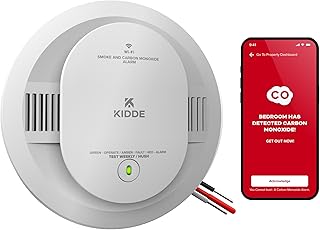
Kidde KN-COSM-IBA Hardwired Smoke & CO Alarm
The Kidde KN-COSM-IBA is the basement alarm for a house that already has Kidde wiring. It carries an ionization smoke sensor and an electrochemical carbon monoxide sensor, runs on 120-volt house wiring, and keeps two AA batteries as backup for power cuts. A voice message system announces the hazard aloud, with a spoken "Fire!" for smoke and a spoken "Warning, Carbon Monoxide!" for carbon monoxide, and the pattern repeats until the air clears or the unit is reset. Peak level memory announces "Carbon Monoxide Previously Detected" when the test button is pressed after the unit has sensed carbon monoxide at 100 parts per million or higher, which gives a technician a recorded event to work from even after the basement air has cleared. The hardwired interconnect links up to twenty-four Kidde devices, and the unit is listed to UL 217 and UL 2034.
- Sensors: ionization smoke; electrochemical carbon monoxide
- Power: hardwired 120V AC with 2 AA battery backup
- Interconnect: hardwired, up to 24 Kidde devices
- Listings: UL 217 and UL 2034
- Sound: 85 dB plus voice message system
- Memory: peak level memory for CO at 100 ppm or higher
- Warranty: 10-year limited warranty
The front-load battery door is a small feature with a real benefit in a basement: the two AA backup cells can be swapped without disconnecting the alarm from its mounting bracket, which makes the routine easier in a utility room with a low ceiling and poor light. The voice message system is the bigger benefit, because a basement event needs to be understood upstairs, and a spoken warning carries further than a bare horn through a closed stairwell door. The trade-offs are the replaceable AA cells, which need periodic attention unlike a sealed ten-year battery, and the lack of any app or phone alert. For a basement with a furnace and Kidde wiring, the KN-COSM-IBA is the straightforward swap, and adding one Kidde smart unit to the same circuit brings phone alerts to the whole set.
Pros: Voice messages name the hazard aloud; peak level memory records CO events at 100 ppm or higher; hardwired interconnect up to 24 devices; front-load battery door for easy swaps.
Cons: AA backup cells need periodic replacement; no app or phone alerts; ionization sensor rather than photoelectric.
X-Sense SC07-W Wireless Interconnected Smoke & CO Alarm
The X-Sense SC07-W is the basement alarm for a house with no wiring near the furnace. It carries a photoelectric smoke sensor and an electrochemical carbon monoxide sensor, runs on a sealed lithium battery rated for the full ten-year operational life, and interconnects wirelessly with up to twenty-four X-Sense Link+ alarms, so a basement event sounds every unit upstairs without a single wire. An LCD display shows the carbon monoxide concentration from 30 to 999 parts per million during an alarm event, which gives a responding household or technician a number rather than a bare siren. The unit is listed to UL 217 and UL 2034, carries an 85 dB horn, and measures 146 by 146 by 51 millimeters.
- Sensors: photoelectric smoke; electrochemical carbon monoxide
- Power: sealed 10-year lithium battery
- Interconnect: wireless RF, up to 24 units
- Display: LCD showing CO concentration from 30 to 999 ppm
- Listings: UL 217 and UL 2034
- Sound: 85 dB at 3 meters
- Service life: 10 years
The sealed battery is the whole argument in a basement. A utility room alarm is easy to forget, and a sealed ten-year battery means the power source ages out on the same schedule as the sensor, so there is no separate battery routine to remember. The LCD display is the second argument: when a furnace technician arrives after an alarm, the display shows the concentration the alarm recorded, which helps the technician find the cause. The radio interconnect is the third: a basement unit that links to the bedrooms upstairs is the point of the purchase, and the SC07-W links up to twenty-four units by radio. The limit is the lack of phone alerts on its own, since the SC07-W does not connect to the X-Sense base station, so remote alerts need a different X-Sense model in the set.
Pros: Sealed ten-year battery, no battery chores; LCD carbon monoxide display from 30 to 999 ppm; wireless interconnect up to 24 units; photoelectric and electrochemical sensing.
Cons: No phone alerts on its own; no voice location announcements; does not connect to the X-Sense base station.
First Alert SC5 Hardwired (SMCO600NV-AC)
The First Alert SC5 Hardwired is the connected basement alarm for a Google Home household with wiring near the furnace. It carries a photoelectric smoke sensor and an electrochemical carbon monoxide sensor, runs on 120-volt house wiring with a non-replaceable 3-volt lithium battery as backup, and reports to the Google Home app and the Resideo Connect app. Voice alerts name the hazard type and its location, and the hardwired interconnect links up to eighteen compatible alarms, so a basement event sounds the bedrooms and sends a phone alert at the same time. The maker lists steam-check logic aimed at cutting nuisance alarms, and the unit is listed to UL 217 and UL 2034 with a ten-year limited warranty.
- Sensors: photoelectric smoke; electrochemical carbon monoxide
- Power: hardwired 120V with non-replaceable 3V lithium backup battery
- Connectivity: Wi-Fi; Google Home and Resideo Connect app alerts; hardwired interconnect up to 18 alarms
- Listings: UL 217 and UL 2034
- Sound: 85 dB at 10 feet plus voice alerts naming hazard type and location
- Warranty: 10-year limited warranty
The phone alert is the reason to choose this alarm for a basement. A basement event that happens while the house is empty is exactly the case a phone alert covers, and the SC5 sends it through Google Home with the room name attached. The hardwired power suits a basement with a junction box near the stairwell, and the SC5 fits the same ceiling mount as the Nest Protect, so a household replacing an expired Nest Protect in the basement can swap it without new holes. The trade-offs are the ecosystem, with Google Home only and no Alexa, Apple HomeKit, SmartThings, or Matter support, and the setup, which runs through the First Alert app before the unit appears in Google Home. For a Google household with a furnace in the basement, those limits rarely matter.
Pros: Phone alerts through Google Home; hardwired interconnect up to 18 alarms; voice alerts with location; drop-in replacement for Nest Protect mounts.
Cons: Google Home only, with no Alexa or HomeKit support; setup needs the First Alert app first; no motion-activated night light.
First Alert Onelink Safe & Sound (1039102)
The Onelink Safe and Sound is the basement alarm for a basement that doubles as a living room, a home theater, or a guest suite. It carries a photoelectric smoke sensor and an electrochemical carbon monoxide sensor, runs on 120-volt house wiring with a sealed ten-year lithium battery as backup, and adds a premium speaker with Alexa built in, plus an adjustable nightlight. The Onelink Home app sends remote notifications to a phone or tablet when smoke or carbon monoxide is detected, and the unit also works with Apple HomeKit, so the alarm appears in the Apple Home app. Voice alerts name the type of danger and the location, and the unit is listed to UL 217 and UL 2034 with an 85 dB horn.
- Sensors: photoelectric smoke; electrochemical carbon monoxide
- Power: hardwired 120V with sealed 10-year lithium battery backup
- Connectivity: Wi-Fi; Onelink Home app alerts; Apple HomeKit; Alexa built in; AirPlay 2
- Listings: UL 217 and UL 2034
- Sound: 85 dB horn plus voice alerts naming type and location
- Extras: premium speaker; adjustable nightlight
- Size: 7 x 7 x 2 inches
The speaker is the reason to choose this alarm for a finished basement, and also the reason to think twice for a bare utility room. In a basement living room, a ceiling speaker that fills the space with music is a genuine daily benefit, and Alexa voice control from the ceiling is convenient when your hands are full. In a furnace room, the same speaker is unwanted, and the larger seven-inch square housing is more visible than a standard round alarm. For the safety side, the hardwired power suits a basement with a ceiling box, the sealed ten-year backup battery removes battery chores, and the app sends the phone alert for the hours the basement sits empty. The Onelink line is an older generation, so buyers should check stock and service life before ordering a whole set.
Pros: Alexa speaker and AirPlay 2 in the same ceiling unit; Apple HomeKit support; hardwired power with sealed ten-year backup; adjustable nightlight; remote app notifications.
Cons: Hardwired only, so it needs a ceiling box; larger housing than a standard alarm; speaker adds cost for a bare utility room.
First Alert ZCOMBO Z-Wave Smoke & CO Alarm
The First Alert ZCOMBO is the basement alarm for a house that already runs a Z-Wave security hub. It carries a photoelectric smoke sensor and an electrochemical carbon monoxide sensor, runs on two AA batteries, and mounts anywhere with no wiring at all, which suits a basement utility room with no ceiling box near the furnace. Pair it with a Ring Alarm base station or a SmartThings hub and its smoke and carbon monoxide events flow into the hub app, so the phone alert arrives through the security system the household already checks. The maker lists compliance with UL 217 and UL 2034, plus Z-Wave Plus certification with SmartStart QR pairing, and the unit carries an 85 dB horn.
- Sensors: photoelectric smoke; electrochemical carbon monoxide
- Power: 2 AA batteries
- Connectivity: Z-Wave Plus; SmartStart QR pairing; works with Ring Alarm and SmartThings hubs
- Listings: UL 217 and UL 2034
- Sound: 85 dB horn; single test and silence button
- Warranty: 7-year limited warranty
The Z-Wave approach has a clear strength in a basement: the alert rides on the hub the household already trusts, and hub automations can switch lights on or shut down equipment when the alarm trips, depending on how the hub is configured. Battery life also stretches further than Wi-Fi, because Z-Wave uses far less power, and the hub reports a low battery before the chirping starts, which matters in a basement nobody visits daily. The limit is that without a hub, the ZCOMBO is simply a good basic combo alarm with no phone alerts at all, and it does not interconnect directly with other alarms the way a wired or radio-frequency set does. For a Ring Alarm or SmartThings household with a furnace in the basement, that trade is worth making. For a home with no hub, a Wi-Fi alarm is the simpler path to the same phone alert.
Pros: Alerts flow through Ring Alarm or SmartThings; long battery life on two AA cells; no wiring needed near the furnace; SmartStart QR pairing.
Cons: Needs a compatible Z-Wave hub for any smart feature; no voice location alerts; no direct alarm-to-alarm interconnect.
X-Sense SC01-W Wireless Interconnected Smoke & CO Alarm
The X-Sense SC01-W is the radio alarm for a basement whose walls are thick and whose stairwell is long. It carries a photoelectric smoke sensor and an electrochemical carbon monoxide sensor, runs on a sealed lithium battery rated for the full ten-year operational life, and interconnects wirelessly with up to twenty-four X-Sense Link+ alarms. The maker lists a transmission range of up to 1,640 feet between devices in open air, which gives the network room to cross a basement ceiling, a ground floor, and a top floor. The detector runs an automatic battery and sensor check every sixty seconds, sounds at 85 dB at 10 feet, and is listed to UL 217 and UL 2034.
- Sensors: photoelectric smoke; electrochemical carbon monoxide
- Power: sealed 10-year lithium battery
- Interconnect: wireless RF, up to 24 X-Sense Link+ alarms
- Range: up to 1,640 feet between devices in open air, per maker
- Listings: UL 217 and UL 2034
- Sound: 85 dB at 10 feet
- Size: 5.7 x 5.7 x 2 inches
- Service life: 10 years
The long radio range is the reason to choose this alarm for a basement. A basement unit has to reach the bedrooms two floors up through a concrete ceiling and a stairwell, and a short-range radio link may struggle where a long-range link holds. The automatic check every sixty seconds is the second reason: a basement alarm is easy to forget, and a unit that checks its own battery and sensor every minute gives a quiet assurance that it is still alive. The sealed ten-year battery removes the battery routine entirely. The limit is the lack of phone alerts on its own, since the SC01-W does not connect to the X-Sense base station, so remote alerts need a different X-Sense model in the set. For a basement that needs a radio link to the bedrooms, the SC01-W is the set-and-forget option.
Pros: Sealed ten-year battery, no battery chores; wireless interconnect up to 24 units; long transmission range for thick walls; automatic sensor and battery check every 60 seconds.
Cons: No phone alerts on its own; no voice location announcements; does not connect to the X-Sense base station.
First Alert SC9120B Hardwired Smoke & CO Alarm

The First Alert SC9120B is the hardwired basement alarm for a house where finding the triggering unit matters. It carries an ionization smoke sensor and an electrochemical carbon monoxide sensor, runs on 120-volt house wiring with a 9-volt alkaline battery as backup, and interconnects through the house wiring with other BRK units. The feature that sets it apart is the latching alarm indicator, which shows which unit in the set triggered the alarm, so a household with six interconnected alarms does not have to guess whether the event started in the basement or on the top floor. It carries an 85 dB horn, is listed to UL 217 and UL 2034, and carries a ten-year limited warranty.
- Sensors: ionization smoke; electrochemical carbon monoxide
- Power: hardwired 120V with 9V alkaline battery backup
- Interconnect: hardwired with other BRK units
- Indicator: latching alarm indicator showing which unit triggered
- Listings: UL 217 and UL 2034
- Sound: 85 dB at 10 feet
- Warranty: 10-year limited warranty
The latching indicator is a small feature with a real benefit in a basement. When every alarm in the house sounds at once, the household needs to know where the event started, and a blinking latch on the basement unit answers that question without a room-by-room search. The ionization sensor suits fast flaming fires, and the hardwired link keeps working during an internet outage, which matters in a basement where the router may sit on another floor. The trade-offs are the 9-volt backup battery, which needs periodic replacement unlike a sealed ten-year cell, and the lack of any app or phone alert. For a wired house that wants a reliable interconnect with a clear trigger locator, the SC9120B is the practical pick, and a connected alarm in a central location can add the phone alert if the household wants it.
Pros: Latching indicator shows which unit triggered; hardwired interconnect with BRK units; reliable wired link during internet outages; ionization sensing for fast flaming fires.
Cons: 9V backup battery needs periodic replacement; no app or phone alerts; no voice location announcements.
Buying guide
Start with the maker placement guidance for the exact model, because a basement alarm in the wrong spot reads the wrong air. The user guide gives the distances from the furnace, the boiler, and the water heater, and the ceiling height and the spots to avoid. An alarm mounted directly above a furnace reads the exhaust plume rather than the room air, and an alarm mounted in a damp corner near a laundry sink may suffer from humidity outside its operating range. The maker guidance calls for carbon monoxide alarms on every level with fuel-burning appliances and outside sleeping areas, and the basement unit should sit where it can hear the furnace room and be heard upstairs, which usually means near the stairwell rather than deep in a storage corner.
Check the operating range against the basement. Most combination alarms in this guide list an operating temperature of 40 to 100 degrees Fahrenheit and a humidity range up to 85 or 95 percent relative humidity, non-condensing. A finished basement with heating and a dehumidifier sits comfortably inside those numbers. An unfinished basement that drops near freezing in winter or runs damp in summer may fall outside them, and the alarm should be checked against the maker numbers before it goes up. If the basement runs cold, a hardwired alarm with a sealed battery is a safer choice than a battery alarm whose cells lose capacity in the cold, and the maker page for the exact model lists the range to compare.
Count the alarms before you buy the first one. A basement with fuel-burning appliances needs a combination alarm on that level, plus an alarm on every other level, inside each bedroom, and outside each sleeping area. For most homes that means five to seven units, and the interconnect limit decides whether one network covers the house: twenty-four devices for the Kidde hardwired range and the X-Sense radio range, eighteen for the SC5 wireless link, and sixteen for the First Alert radio line. Alarms from different brands generally do not interconnect, so a whole-house set should stay within one brand family, and the maker compatibility list should be checked for the exact models.
Choose the link type by the wiring the basement already has. A basement with a junction box near the stairwell should use hardwired interconnect, because the link runs on house wiring and keeps working during an internet outage. A basement with no wiring should use radio interconnect, because battery alarms link through the air with no new wire through a finished ceiling. A house with wiring on some floors and none on others can mix the two, but only inside one brand family. The SC07-W and the SC01-W both link a basement unit to the bedrooms by radio, while the Kidde and BRK hardwired models link through the house wiring.
Weigh the information the alarm gives after it sounds. A carbon monoxide display that shows the concentration, like the SC07-W, gives a responding household or technician a number. Peak level memory, like the KN-COSM-IBA, records that carbon monoxide reached 100 parts per million or higher even after the air has cleared. A voice warning that names the hazard, like the SC5 and the Safe and Sound, turns a bare horn into directions. A latching indicator, like the SC9120B, shows which unit triggered. In a basement, where the event may be over before anyone arrives, that recorded information is worth having, because the technician who arrives later needs to know what happened, not just that something happened.
Finally, plan for the furnace service, not just the alarm. A combination alarm is a warning device, and the maker guidance for every model here describes the alarm as a way to detect smoke and carbon monoxide, not as a substitute for maintaining the appliance. Keep the furnace, the boiler, and the water heater on their maker service schedules, keep the flue and the vents clear, and follow the maker instructions for the alarm itself, including the monthly button check and the ten-year replacement date. Write the replacement date on the alarm when you install it, set a calendar reminder for that month, and check the app monthly if the alarm is a connected model, so a dropped connection is noticed before an emergency.
FAQ
Where should a smoke and CO detector go in a basement with a furnace?
Follow the maker user guide for the exact model. The guidance calls for a combination alarm on every level with fuel-burning appliances, near the stairwell where it can be heard upstairs, and at the maker-stated distance from the furnace, the boiler, and the water heater. Avoid mounting directly above the appliance, where the alarm reads the exhaust plume rather than the room air, and avoid damp corners that fall outside the maker humidity range.
Can a basement get too cold or damp for a smoke and CO alarm?
It can. Most combination alarms in this guide list an operating temperature of 40 to 100 degrees Fahrenheit and a humidity range up to 85 or 95 percent relative humidity, non-condensing. A finished basement with heating and a dehumidifier sits inside those numbers. An unfinished basement that drops near freezing or runs damp may fall outside them, so check the maker numbers for the exact model against the basement before installing.
Will a basement alarm wake the bedrooms upstairs?
Yes, when the alarms are interconnected. Hardwired alarms link through house wiring, radio alarms link through radio frequency, and a smart alarm may link through either. When one alarm trips, every alarm in the set sounds at once, so a basement event wakes the top floor. A standalone alarm with no interconnect sounds only in its own room, which is why interconnection matters most in a multi-level house.
What does the CO display on the X-Sense SC07-W show?
The LCD display shows the carbon monoxide concentration from 30 to 999 parts per million during an alarm event. That number gives a responding household or technician a reading to work from, rather than a bare siren. The maker lists the UL 2034 response pattern for the alarm, and the display is a readout of the concentration the sensor measured.
Should the basement alarm send alerts to my phone?
Phone alerts are worth having for a basement, because the basement often sits empty for hours and a furnace event may start while nobody is home. The SC5 Hardwired and the Onelink Safe and Sound send phone alerts through their apps, and the ZCOMBO sends alerts through a Z-Wave hub app. The phone alert is an extra layer, and the local horn and the interconnect remain the primary warning.
How often should a basement alarm be checked?
The maker guidance for these models calls for a monthly button check and a look at the app status for connected models. The alarm should be replaced at the end of its maker-stated service life, usually ten years from the date of manufacture, even if it still sounds during a button test. Write the replacement date on the alarm when you install it and set a calendar reminder for that month.
Conclusion
A basement with fuel-burning appliances needs a combination alarm that senses both smoke and carbon monoxide, links to the bedrooms upstairs, and gives useful information after it sounds. The Kidde KN-COSM-IBA is the hardwired choice for a Kidde house, with a voice message system and peak level memory that records carbon monoxide at 100 parts per million or higher. The X-Sense SC07-W is the battery choice for a basement with no wiring, with a sealed ten-year battery, radio interconnect for up to twenty-four units, and an LCD display that shows the concentration. The First Alert SC5 Hardwired brings phone alerts to a Google Home basement, the Onelink Safe and Sound brings a speaker and HomeKit to a finished basement, the ZCOMBO brings Z-Wave alerts to a hub household, the X-Sense SC01-W brings long-range radio links to thick walls, and the First Alert SC9120B brings a latching indicator that shows which unit triggered.
Whichever alarm fits the basement, follow the maker placement guidance, check the operating temperature and humidity against the room, and keep the set inside one brand family so the interconnect holds. Install the alarm near the stairwell where it can be heard upstairs, name each unit by its room, and write the replacement date on each unit as you install it. The furnace, the boiler, and the water heater deserve their service schedules, and the alarm deserves its monthly check, so the warning is there on the day it is needed.
Related guides
More from Amazon
Programs that pair well with the guide above. Offers and eligibility are set by Amazon and may change.
Collect the home and kitchen items you want in one registry that guests can shop from.
Create a wedding registrySet up recurring deliveries of everyday items on eligible products. Terms and savings are set by Amazon.
Explore Subscribe & SaveFree shipping on eligible items, Prime Video and more. Eligible new members can start with a free trial.
Start a Prime free trialAudiobooks and podcasts to listen to on the go. Eligible new members can start with a free trial.
Try Audible freeAs an Amazon Associate we earn from qualifying purchases.
More ways to save on your next project
Programs that pair well with the guide above. Offers and eligibility are set by Amazon and may change.
A free business account with business pricing and bulk-buying tools for work, shop or home office.
Create a business accountFast, free shipping on eligible items, plus Prime Video and more. Eligible new members can start with a free trial.
Start a Prime free trialAudiobooks and podcasts for the commute, the garage or the kitchen. Eligible new members can start with a free trial.
Try Audible freeA dedicated Amazon storefront for low-price finds. Offers and eligibility are set by Amazon.
Browse Amazon HaulAs an Amazon Associate we earn from qualifying purchases. Using these links costs you nothing extra.




Write Your Review
No reviews yet. Be the first to share your experience!