
Key takeaways
- Compare smart smoke and CO detectors with app alerts for basements with fuel-burning appliances, plus hardwired and battery picks and remote monitoring today.
What's inside
As an Amazon Associate I earn from qualifying purchases. This post may contain affiliate links at no extra cost to you.
A basement with a furnace, a boiler, or a water heater asks more from a smoke and carbon monoxide alarm than a hallway on the main floor does. The room is often cooler, damper, and visited less often, while the appliances in it burn fuel and need steady venting. A detector that only sounds in the basement may not be heard from a bedroom two floors up, and a detector with no remote alert cannot tell you anything while you are at work or away for the weekend. That is why the best smart smoke and CO detectors with app alerts for away from home for basements with fuel burning appliances pair two kinds of sensing in one head with a phone alert that travels with you. The seven models below were picked from a verified pool because six of them send smoke and carbon monoxide alerts to a phone app, and the seventh, the First Alert SCO500B, links by wireless radio to the app-connected alarms in the same set, so a basement event sounds the alarms that do send the alert. Each one fits a realistic basement layout, whether the basement has existing alarm wiring, a strong Wi-Fi signal, or neither. Hardwired models suit basements that already have alarm wiring near the furnace room, while battery and hub models suit finished basements and utility corners where pulling new wire is not practical. Before buying, check the temperature and humidity range the maker lists for each model, because basements run colder and damper than living rooms, and check whether the alarm needs a hub, a 2.4 GHz Wi-Fi network, or a hardwired circuit. The right pick is the one whose power source, radio, and app all match the basement you actually have, not the one with the longest feature list.
Quick verdict
For most basements with fuel-burning appliances and existing alarm wiring, the First Alert SC5 Hardwired (SMCO600NV-AC) is the pick that covers the most ground: it is hardwired with battery backup, it sends alerts through the Resideo Connect app and Google Home, it names the hazard type and its location by voice, and it interconnects with other compatible alarms so a basement event sounds through the house. If the basement has no alarm wiring, the Kidde 30CUAR-W is the hardwired alternative only when a circuit is present, so for a truly wire-free basement the X-Sense SC07-MR with its base station or the First Alert ZCOMBO through a Z-Wave hub are the more practical routes, since both send phone alerts without new wiring. Households that already run a Kidde hardwired network should look at the Kidde P4010ACSCOAQ-WF first, because it joins the existing hardwired Kidde network with real-time mobile alerts and adds indoor air quality readings for damp basements where temperature and humidity matter, and the Kidde 30CUAR-W relays mobile alerts for the existing hardwired Kidde alarms in the home while adding phone hush. The First Alert Onelink Safe & Sound (1039102) suits Apple households that want HomeKit, a built-in Alexa speaker, and voice location alerts from a hardwired head. Buy the hardwired model when the wiring is already there, buy the hub or battery model when it is not, and always place the alarm where the maker guidance says it belongs relative to fuel-burning appliances.
| Product | Key spec | Best for |
|---|---|---|
| First Alert SC5 Hardwired (SMCO600NV-AC) | Hardwired 120V, lithium backup, Resideo Connect app, voice location alerts | Basements with existing wiring |
| First Alert ZCOMBO Z-Wave Smoke & CO Alarm | Z-Wave Plus, 2 AA batteries, hub app alerts, photoelectric and electrochemical sensing | Hub homes without new wiring |
| First Alert Onelink Safe & Sound (1039102) | Hardwired 120V, sealed 10-year lithium backup, Alexa speaker, HomeKit, voice location alerts | Apple households wanting a speaker and HomeKit |
| Kidde P4010ACSCOAQ-WF Smart Smoke + CO Alarm with IAQ Monitor | Hardwired 120V, Kidde app, indoor air quality monitor, voice alerts | Damp basements needing air readings |
| X-Sense SC07-MR Smart Smoke & CO Alarm | CR123A battery up to 5 years, app alerts through SBS50 base station, RF interconnect | Wire-free basements with a base station |
| Kidde 30CUAR-W Smart Smoke + CO Alarm | Hardwired 120V, 2 AA backup, Kidde app, phone hush, voice alerts | Hardwired homes wanting phone hush |
| First Alert SCO500B Wireless Interconnected Smoke & CO Alarm | 2 AA lithium batteries, wireless RF interconnect up to 16 alarms, voice alerts with 11 locations | Wire-free basements needing voice-location coverage |
How we chose
Every model in this guide had to meet three conditions drawn from the keyword itself. First, it had to detect both smoke and carbon monoxide in one unit, with the sensing types the maker lists: a photoelectric smoke sensor and an electrochemical carbon monoxide sensor in nearly every case, since that combination is the one makers list for the smoldering fires and slow carbon monoxide build-up that matter around fuel-burning appliances. Second, it had to send alerts to a phone app when the household is away from home, whether over Wi-Fi, through a Z-Wave hub, or through a maker base station, because a basement alarm that only sounds locally cannot help a household that is out. The First Alert SCO500B is the one exception, and it is included because its wireless radio link carries a basement event to the app-connected alarms in the same set, which is a legitimate role in a basement, provided the buyer understands that the unit itself sends no phone alert. Third, it had to suit a basement with fuel-burning appliances, which meant checking the operating temperature and humidity range the maker lists, the power source, and the placement guidance for rooms with furnaces, boilers, and water heaters. Models that only sound locally were left out, and models that only detect smoke were left out too. We also favored models whose makers list UL 217 for smoke and UL 2034 for carbon monoxide, and we noted the interconnect behavior of each model, because a basement event should reach the alarms on the floors where people sleep. Battery life, backup power, and whether the app needs a 2.4 GHz network were all weighed, since basements often sit far from the router and lose power first in a storm. The result is a set of seven alarms that covers hardwired basements, wire-free basements, hub homes, Apple homes, and Kidde networks, so the shortlist matches the basement rather than forcing the basement to match the alarm.
First Alert SC5 Hardwired (SMCO600NV-AC)
The First Alert SC5 Hardwired (SMCO600NV-AC) is the lead pick for basements that already have alarm wiring, and the reasons stack up quickly. The product page lists photoelectric smoke sensing and electrochemical carbon monoxide sensing in one head, hardwired 120 volt power with a non-replaceable 3 volt lithium backup, and alerts through the Resideo Connect app with Google Home compatibility, so a smoke or carbon monoxide event in the basement reaches your phone while you are away. The voice alerts name the hazard type and its location, which matters in a basement where a voice from the stairwell may be the first thing a household hears, and the maker lists hardwired interconnect with up to 18 alarms, so the basement unit can sound the alarms upstairs as well. Precision Detection is the maker name for the sensing logic aimed at cutting cooking nuisance alarms, and the maker lists an 85 decibel horn at 10 feet, a 10 year limited warranty, and conformity to UL 217 and UL 2034. The Quick Connect plug means a swap onto an existing hardwired box needs no rewiring, and the maker notes that the SC5 works with existing Google Nest Protect alarms in the same home through the Google Home app, which helps households that are replacing units one at a time. For a basement with a furnace, the hardwired power removes battery-change chores, and the backup cell keeps the unit running when the power drops.
- Power: hardwired 120V with non-replaceable 3V lithium backup
- Sensors: photoelectric smoke; electrochemical carbon monoxide
- App: Resideo Connect app; Google Home compatible
- Voice: alerts naming hazard type and location
- Horn: 85 dB at 10 feet
- Listings: conforms to UL 217 and UL 2034
- Warranty: 10 years limited
Pros: Hardwired power with backup suits a basement that already has wiring; app alerts plus voice location alerts cover away-from-home and at-home needs; interconnect reaches upstairs alarms.
Cons: Needs an existing hardwired box; backup battery is not replaceable, so the unit is replaced when the backup ends.
First Alert ZCOMBO Z-Wave Smoke & CO Alarm
The First Alert ZCOMBO suits a basement where there is no alarm wiring and no wish to add any, because its Z-Wave radio carries alerts to the phone through a compatible hub instead of through Wi-Fi. The maker lists photoelectric smoke sensing and electrochemical carbon monoxide sensing, two AA batteries, Z-Wave Plus with SmartStart QR pairing, and an 85 decibel horn, with UL 217 and UL 2034 listings and a 7 year limited warranty. Paired with a Ring Alarm base station or a SmartThings hub, the alarm pushes smoke and carbon monoxide alerts to the phone anywhere, and the hub can also switch on lights or run other automations when the alarm sounds. The battery power means the unit mounts anywhere a bracket can go, which helps in basements where the only good ceiling spot sits far from any junction box, and Z-Wave uses far less power than Wi-Fi, so the cells last for years. The trade is that the ZCOMBO has no voice alerts and no room naming, so locating the event means opening the app or walking the house, and without a hub it behaves as an ordinary local alarm. For a basement in a home that already runs a Z-Wave hub, though, it is one of the simplest ways to add app alerts to a room that never had wiring.
- Power: 2 AA batteries
- Sensors: photoelectric smoke; electrochemical carbon monoxide
- Radio: Z-Wave Plus with SmartStart QR pairing
- Hubs: Ring Alarm and SmartThings, plus other Z-Wave controllers
- Horn: 85 dB
- Listings: UL 217 and UL 2034
- Warranty: 7 years limited
Pros: Battery power and Z-Wave keep installation simple in a wire-free basement; hub app alerts reach the phone anywhere; low radio power stretches battery life.
Cons: No voice alerts and no room naming; a compatible hub is required for any smart feature.
First Alert Onelink Safe & Sound (1039102)
The First Alert Onelink Safe & Sound is the hardwired pick for Apple households that want their basement alarm to do double duty as a room speaker, and it brings voice location alerts and app notifications to the same head. The maker lists photoelectric smoke sensing and electrochemical carbon monoxide sensing, hardwired 120 volt power with a sealed 10 year lithium battery backup, and a built-in speaker with Amazon Alexa and AirPlay 2, plus Apple HomeKit and remote notifications through the Onelink Home app. The voice alerts name the hazard type and its location, the horn sounds at 85 decibels, and the head measures 7 by 7 by 2 inches, with an adjustable nightlight that can be set from the app. For a basement with a furnace, the hardwired power and sealed backup mean the alarm keeps working through a power cut, and the HomeKit link puts the alarm in the same app as the rest of an Apple household, with alerts on the phone while the household is away. The speaker means the alarm can answer Alexa requests and play audio in a finished basement living area, so the head earns its ceiling spot even on quiet days. The trade is the hardwired requirement and the size: the square head is larger than a plain alarm, and the smart speaker features need Wi-Fi to do anything beyond local alarming.
- Power: hardwired 120V with sealed 10-year lithium battery backup
- Sensors: photoelectric smoke; electrochemical carbon monoxide
- App: Onelink Home app remote notifications; Wi-Fi
- Smart home: Apple HomeKit; built-in Alexa speaker with AirPlay 2
- Voice: alerts naming type and location
- Horn: 85 dB
- Size: 7 x 7 x 2 in
- Extras: adjustable nightlight
Pros: HomeKit, Alexa, and a built-in speaker fit Apple households; sealed 10-year backup and hardwired power suit a furnace basement; voice location alerts name the room.
Cons: Needs an existing hardwired box; the head is larger than a plain alarm and the speaker features need Wi-Fi.
Kidde P4010ACSCOAQ-WF Smart Smoke + CO Alarm with IAQ Monitor
The Kidde P4010ACSCOAQ-WF takes the same hardwired smart alarm as its sibling and adds indoor air quality readings, which makes it the most informative pick for a damp basement where temperature and humidity swing with the seasons. The maker lists photoelectric smoke sensing, electrochemical carbon monoxide sensing, and an indoor air quality monitor that reads temperature, relative humidity, and total volatile organic compounds, all in one hardwired head with a sealed 10 year lithium battery backup. Wi-Fi carries real-time mobile alerts to the Kidde app, and the maker lists Google Assistant and Alexa status checks, hardwired interconnect with up to 24 Kidde devices, an 85 decibel horn, and UL 217 and UL 2034 listings. For a basement with a furnace, a water heater, and stored paint or solvents, the air quality readings give a household a reason to open the app even on quiet days, and a rising humidity reading can flag a damp problem before it becomes a mold problem. The voice alerts announce the hazard type, and the sealed backup means no battery changes for the life of the alarm. The trade is the same as any hardwired model: the basement needs an existing 120 volt alarm circuit, and the Wi-Fi features need a 2.4 GHz network that reaches the basement ceiling.
- Power: hardwired 120V with sealed 10-year lithium backup
- Sensors: photoelectric smoke; electrochemical carbon monoxide; indoor air quality monitor
- Air readings: temperature; relative humidity; total volatile organic compounds
- App: Kidde app real-time mobile alerts; Wi-Fi
- Voice: voice alerts announcing hazard type
- Interconnect: hardwired up to 24 Kidde devices
- Horn: 85 dB
- Listings: UL 217 and UL 2034
Pros: Air quality readings add temperature and humidity context for damp basements; one unit relays phone alerts for a Kidde hardwired network; sealed backup ends battery changes.
Cons: Needs a hardwired circuit and 2.4 GHz Wi-Fi in the basement; air readings are extra information, not a substitute for alarm placement.
X-Sense SC07-MR Smart Smoke & CO Alarm
The X-Sense SC07-MR suits a finished basement where there is no alarm wiring and no hub, because its app alerts travel through a small base station rather than through the alarm itself. The maker lists photoelectric smoke sensing and electrochemical carbon monoxide sensing, a replaceable CR123A battery rated up to 5 years, RF interconnect with X-Sense Link+ Pro alarms, and app alerts with remote silence through the X-Sense Home Security app when the SBS50 base station is connected. The base station is sold separately, and it links the alarms to 2.4 GHz Wi-Fi, so the phone alerts work while the household is away from home. The maker lists an 85 decibel horn, a 10 year product life, an operating temperature of 40 to 100 degrees Fahrenheit, and a 5 year warranty. For a basement that was finished without alarm wiring, the radio interconnect means one alarm can sound the others without any cable, and the long battery life means the ceiling unit can sit untouched for years. The base station is the extra purchase to budget for, and the basement needs a spot for it within radio range of the alarms and near the router, but once it is in place the whole basement gains phone alerts without a single new wire.
- Power: replaceable CR123A battery rated up to 5 years
- Sensors: photoelectric smoke; electrochemical carbon monoxide
- App: X-Sense Home Security app alerts through SBS50 base station, sold separately
- Radio: RF interconnect with X-Sense Link+ Pro alarms; 2.4 GHz Wi-Fi through base station
- Horn: 85 dB
- Product life: 10 years
- Operating temperature: 40-100F
- Warranty: 5 years
Pros: Long battery life and radio interconnect suit a finished basement with no wiring; app alerts and remote silence work through the base station; no hub or alarm circuit needed.
Cons: The SBS50 base station is sold separately and must sit within range; the alarm has no Wi-Fi radio of its own.
Kidde 30CUAR-W Smart Smoke + CO Alarm
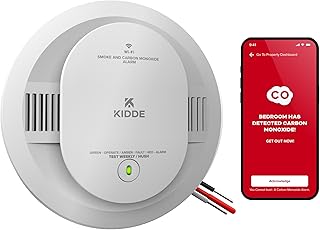
The Kidde 30CUAR-W is the hardwired smart alarm for basements where the household wants to hush a nuisance alarm from the phone instead of climbing a ladder. The maker lists photoelectric smoke sensing and electrochemical carbon monoxide sensing, hardwired 120 volt AC power with two AA backup batteries, Wi-Fi on 2.4 GHz, and the Kidde app with real-time notifications and phone hush, plus voice alerts and compatibility with Alexa and Google Home. One smart alarm relays mobile alerts for the existing hardwired Kidde alarms in the home, and the hardwired interconnect covers up to 24 Kidde devices, so a basement furnace-room event reaches the phone and the upstairs alarms together. The maker lists an 85 decibel horn at 10 feet, UL 217 and UL 2034 listings, and a 10 year limited warranty. The sensing is tuned to cut cooking nuisance alarms, which matters less in a basement than in a kitchen but still helps near a laundry area, and the AA backup cells are easy to swap when the app reports a low battery. For a basement that already has a hardwired box and a household that wants phone control, this model is the most direct swap, with the only real demand being a 2.4 GHz network that reaches the basement.
- Power: hardwired 120V AC with 2 AA backup batteries
- Sensors: photoelectric smoke; electrochemical carbon monoxide
- App: Kidde app real-time notifications and phone hush; Wi-Fi 2.4 GHz
- Voice: voice alerts announcing hazard type
- Interconnect: hardwired up to 24 Kidde devices; relays alerts for existing hardwired Kidde alarms
- Horn: 85 dB at 10 feet
- Listings: UL 217 and UL 2034
- Warranty: 10 years limited
Pros: Phone hush avoids ladder trips for nuisance alarms; one unit relays alerts for the whole Kidde hardwired network; AA backup cells are simple to replace.
Cons: Needs a hardwired circuit and 2.4 GHz Wi-Fi; backup batteries need periodic replacement unlike sealed models.
First Alert SCO500B Wireless Interconnected Smoke & CO Alarm
The First Alert SCO500B is the wireless voice-location link for basements where no phone-alert head fits the ceiling, and it earns its place by tying the basement into the alarms that do report to the phone. The maker lists photoelectric smoke sensing and electrochemical carbon monoxide sensing, two AA lithium batteries, and a wireless RF interconnect that links up to 16 compatible alarms on a 915 MHz mesh network, so one alarm sounding in the basement sets off the others through the house. The voice alerts speak from 11 pre-programmed locations, which means the alarm can announce the room as well as the hazard, and the maker lists an 85 decibel horn, a 7 year service life, a 7 year limited warranty, and UL 217 and UL 2034 listings, in a head measuring 5.13 by 5.13 by 2.8 inches. The battery power means the unit mounts anywhere a bracket can go, which helps in basements where the only good ceiling spot sits far from any junction box, and the radio interconnect needs no wiring at all. The buyer should understand the limit: this unit itself sends no phone alert, so it belongs in a set where the app-connected alarms carry the remote reporting, and a basement event it detects reaches the phone through those linked alarms. For a finished basement or a utility corner with no wiring and weak Wi-Fi at the ceiling, the SCO500B is the practical way to add voice-location coverage without opening the ceiling.
- Power: 2 AA lithium batteries
- Sensors: photoelectric smoke; electrochemical carbon monoxide
- Interconnect: wireless RF up to 16 compatible alarms on 915 MHz mesh network
- Voice: alerts with 11 pre-programmed locations
- Horn: 85 dB
- Service life: 7 years
- Listings: UL 217 and UL 2034
- Warranty: 7 years limited
- Size: 5.13 x 5.13 x 2.8 in
Pros: Wireless interconnect links up to 16 alarms with no wiring; voice alerts name the location from 11 pre-programmed choices; battery power mounts anywhere.
Cons: Sends no phone alert of its own, so it needs app-connected alarms in the same set for remote reporting; 7-year service life is shorter than the 10-year heads here.
Buying guide
Start with power, because power decides everything else in a basement. If the basement ceiling already has a hardwired alarm box, a hardwired model with battery backup is the natural fit: it draws from the house circuit, keeps working through a power cut on its backup cell, and interconnects with the alarms upstairs over the same wiring. If there is no box, a battery model or a hub model is the answer, and the choice then turns on the radio: Wi-Fi models need a 2.4 GHz network that reaches the basement, Z-Wave models need a compatible hub, and base-station models need a spot for the base station within radio range. Check the router signal at the exact ceiling spot before buying, since a basement far from the router may need a network extender or a hub model instead. Next, check the operating range the maker lists. Most makers list 40 to 100 degrees Fahrenheit and 10 to 95 percent relative humidity, which covers most basements, but an unheated basement in a cold climate or a damp basement near a sump pump deserves a careful look at those numbers. Placement matters as much as the model: follow the maker guidance and local code on distance from fuel-burning appliances, since an alarm mounted too close to a furnace can sound nuisance alarms, while one mounted too far away may respond late. A good rule is to place the alarm on the ceiling near the stairs leading up from the basement, so an event is heard on the way out, plus coverage near sleeping areas upstairs through interconnect. Interconnect is the third thing to weigh. Hardwired interconnect links alarms over house wiring, radio interconnect links them without wire, and some smart models relay alerts for older alarms on the same circuit, so one smart head can give phone alerts to a whole network. Voice alerts deserve attention too: a voice that names the hazard type and the room helps a household act correctly in the dark, and it helps guests and children who may not know which alarm is sounding. Battery strategy is the fourth check. Sealed 10 year batteries end battery chores for the life of the alarm, while replaceable cells need a calendar reminder and a note of the cell type, and hardwired models with AA backup need the same. App behavior is the fifth check: confirm the app sends smoke, carbon monoxide, and low-battery alerts, confirm whether silencing works from the phone, and confirm that alerts arrive without a subscription where that matters. Finally, check the listings. Makers list UL 217 for smoke alarms and UL 2034 for carbon monoxide alarms, and a combination alarm should list both. Replace any alarm at the end of the service life the maker lists, usually 10 years, and write the install date on the unit so the replacement date is never a guess.
FAQ
Do smart smoke and CO detectors send alerts when I am away from home?
Yes, when the alarm has a working path to the phone. Wi-Fi models send alerts through the maker app over the home network, Z-Wave models send them through the hub app, and base-station models send them through the base station link. The alerts need a live network at home and a phone with data, so a dead router or a flat phone battery breaks the chain. The local horn still sounds on its own, since the sensing and the horn do not depend on the network.
Where should I place a smoke and CO detector in a basement with a furnace?
Follow the maker guidance and local code for the exact distances, and as a starting point place the alarm on the ceiling near the stairs from the basement, not directly above or beside the furnace, boiler, or water heater. Fuel-burning appliances need clear space around them so routine operation does not set off nuisance alarms, and the alarm should still sit where it can sample the air of the room. Interconnect the basement alarm with the alarms on the sleeping floors so an event is heard where people sleep.
Can one smart alarm give phone alerts for older alarms in the same house?
Some models can. Kidde lists that adding one smart alarm relays mobile alerts for existing hardwired Kidde alarms on the same circuit, and First Alert lists interconnect between compatible hardwired alarms. The relay only works inside the same maker family and the same wiring or radio network, so check the compatibility list for the exact models already on the ceiling before counting on it.
Do I need a hub for app alerts in the basement?
It depends on the radio. Wi-Fi alarms connect straight to the router and need no hub, but they need a 2.4 GHz network that reaches the basement. Z-Wave alarms need a compatible hub such as a Ring Alarm base station or a SmartThings hub, and base-station models need the maker base station. Read the connectivity line on the product page before buying, and confirm the hub or router is already in the home.
How long do the batteries last in a basement smoke and CO detector?
It varies by model. Sealed lithium backups are listed for the 10 year life of the alarm, replaceable CR123A cells are listed up to 5 years in the X-Sense model here, and AA cells in hardwired models are backup only and last longer than in battery-only models. Cold basements can shorten battery life, so follow the operating temperature the maker lists and replace cells when the app reports a low battery rather than waiting for a chirp.
What do UL 217 and UL 2034 mean on a combination alarm?
UL 217 is the standard makers list for smoke alarms and UL 2034 is the standard makers list for carbon monoxide alarms in the United States. A combination alarm that lists both has been evaluated against both standards. The listings describe the alarm and its sensing, and they do not change the need for correct placement, regular checks, and replacement at the end of the service life the maker lists.
Conclusion
A basement with fuel-burning appliances deserves an alarm that senses both smoke and carbon monoxide and can reach your phone while you are away, and the right model is the one whose power and radio match the basement. The First Alert SC5 Hardwired (SMCO600NV-AC) leads for basements with existing wiring, the Kidde P4010ACSCOAQ-WF leads for Kidde hardwired networks, and the ZCOMBO and X-Sense SC07-MR lead for basements with no wiring at all. Check the temperature and humidity range, confirm the network reaches the ceiling spot, place the alarm where the maker guidance says it belongs, and interconnect it with the alarms upstairs. Then the basement stops being the quiet corner of the house and becomes part of a network that speaks up wherever you are.
Related guides
More from Amazon
Programs that pair well with the guide above. Offers and eligibility are set by Amazon and may change.
Collect the home and kitchen items you want in one registry that guests can shop from.
Create a wedding registrySet up recurring deliveries of everyday items on eligible products. Terms and savings are set by Amazon.
Explore Subscribe & SaveFree shipping on eligible items, Prime Video and more. Eligible new members can start with a free trial.
Start a Prime free trialAudiobooks and podcasts to listen to on the go. Eligible new members can start with a free trial.
Try Audible freeAs an Amazon Associate we earn from qualifying purchases.
More ways to save on your next project
Programs that pair well with the guide above. Offers and eligibility are set by Amazon and may change.
A free business account with business pricing and bulk-buying tools for work, shop or home office.
Create a business accountFast, free shipping on eligible items, plus Prime Video and more. Eligible new members can start with a free trial.
Start a Prime free trialAudiobooks and podcasts for the commute, the garage or the kitchen. Eligible new members can start with a free trial.
Try Audible freeA dedicated Amazon storefront for low-price finds. Offers and eligibility are set by Amazon.
Browse Amazon HaulAs an Amazon Associate we earn from qualifying purchases. Using these links costs you nothing extra.




Write Your Review
No reviews yet. Be the first to share your experience!