
Key takeaways
- Compare smart smoke and CO detectors with voice location alerts for vacation homes, with remote app monitoring, hardwired and battery options listed inside.
What's inside
As an Amazon Associate I earn from qualifying purchases. This post may contain affiliate links at no extra cost to you.
A vacation home sits empty for weeks at a time, and that emptiness changes what a smoke and carbon monoxide alarm has to do. Nobody is there to hear a horn, nobody is there to notice a low-battery chirp, and a neighbor may be the first person to notice anything at all. A voice that names the room and the hazard helps the people who are there, and a phone alert helps the owner who is not. That is the pair this guide is built around: the best smart smoke and CO detectors with voice location alerts for vacation homes monitored remotely speak the location of an event out loud and send the same information to a phone app, so an empty house can still report on itself. The six models below were picked from a verified pool because four of them name the hazard type and its location by voice and send alerts to a phone while the owner is away, and the two Kidde hardwired heads announce the hazard by voice and link by hardwired interconnect to the alarms that do report to the phone. Battery models suit cabins and cottages with no alarm wiring, hardwired models suit vacation homes that already have alarm circuits, and the mix here lets a household cover a whole property with the app-connected heads in one app and the hardwired voice heads linked by interconnect, instead of a shelf of mismatched alarms. Before buying, confirm the Wi-Fi situation at the property, because a vacation home with a router that sleeps, a seasonal internet plan, or a weak signal at the far bedrooms will not deliver remote alerts reliably, and confirm which app each alarm uses so the whole house lands in one place.
Quick verdict
For most vacation homes, the Google Nest Protect is the pick that sets the standard for this category: it speaks the hazard and the room, sends alerts to the phone, and runs a nightly check that reports problems before they become emergencies, in both a battery version and a wired version. The First Alert SC5 Battery (SMCO600NV) is the natural partner and successor for rooms without wiring, carrying voice location alerts and app alerts through the Resideo Connect app and Google Home, while the Kidde i12010SCO and KN-COSM-IBA cover the wired rooms with voice warnings and hardwired interconnect. The First Alert Onelink Safe & Sound (1039102) suits vacation homes where a hardwired head with a built-in speaker and HomeKit fits the plan, while the Onelink Smoke & CO Alarm Battery (1042136) covers the same voice and app behavior in battery form for households that want a simpler head without the speaker. Pick the Nest Protect (2nd Gen) or the SC5 Battery for the rooms that matter most, match the power source to the wiring in each room, and keep the app-connected alarms in one app so a single glance shows the whole property.
| Product | Key spec | Best for |
|---|---|---|
| Google Nest Protect (2nd Gen) | Split-spectrum smoke sensing, spoken room alerts, Nest app, battery or wired | The standard voice alert pick |
| First Alert SC5 Battery (SMCO600NV) | 6 CR123A batteries, Resideo Connect app, voice location alerts | Rooms without alarm wiring |
| Kidde i12010SCO Hardwired Smoke & CO Alarm | Ionization smoke, electrochemical CO, voice warning, hardwired interconnect up to 24 | Wired rooms needing a voice warning |
| First Alert Onelink Safe & Sound (1039102) | Hardwired 120V, Alexa speaker, HomeKit, voice location alerts | Hardwired homes wanting a speaker |
| Kidde KN-COSM-IBA Hardwired Smoke & CO Alarm | Ionization smoke, electrochemical CO, voice messages, hardwired interconnect up to 24 | Wired rooms needing voice messages |
| First Alert Onelink Smoke & CO Alarm Battery (1042136) | Battery powered, Wi-Fi, HomeKit, voice location alerts | Apple homes without wiring |
How we chose
Every model here had to meet two conditions at once, because the keyword asks for two behaviors that do not always travel together. First, the alarm had to speak the hazard by voice, with the app-connected heads naming the hazard type and its location, not merely sound a horn or flash a light, so a person in the house hears which room and which hazard is involved without walking the halls. Second, it had to send alerts to a phone app while the owner is away from the property, because a vacation home is empty most of the time and the owner is often hours away. The two Kidde hardwired heads are the exceptions to the second condition, and they are included because their voice warnings announce the hazard and their hardwired interconnect carries a vacation home event to the app-connected alarms in the same set, which is a legitimate role in a vacation home, provided the buyer understands that the units themselves send no phone alert. We also weighed the power source, since vacation homes mix wired rooms and unwired additions, and we favored models whose makers list UL 217 for smoke and UL 2034 for carbon monoxide, plus interconnect behavior that lets one alarm sound the others. Battery life and backup power mattered more here than in a primary home, because a vacation home alarm may go months without a visit, so sealed long-life batteries and low-battery phone alerts counted heavily. The app behavior mattered as well: the app should report smoke, carbon monoxide, and low-battery states, and it should allow silencing from the phone where the maker lists that feature. The result is six alarms that all speak, four of which also report to the phone, in battery and hardwired forms, so a household can cover a vacation property room by room.
Google Nest Protect (2nd Gen)
The Google Nest Protect is the lead pick because it defined the voice alert category and still does it more clearly than anything else in the pool. The maker lists a split-spectrum smoke sensor that reads two light wavelengths to catch both fast flaming fires and slow smoldering ones, a 10 year electrochemical carbon monoxide sensor, a heat sensor, a humidity sensor, and an occupancy sensor, with spoken alerts that name the hazard and the room, phone alerts through the Nest app, and a wireless interconnect between units. The battery version runs on six long-life AA lithium cells and the wired version runs on 120 volts with three AA lithium backup cells, so the same alarm fits a wired hallway and an unwired cabin bedroom. The maker lists an 85 decibel horn at 10 feet, an 80 decibel spoken voice at 3 feet, a 10 year service life, and UL 217 and UL 2034 listings, plus a nightly promise check that flashes green when the sensors, speaker, and Wi-Fi all report well. The app hush quiets a nuisance alarm from the phone, and the safety history in the app shows past events for a property the owner visits only a few times a year. Google ended production of the Nest Protect in March 2025 and points owners toward the First Alert SC5 as the replacement, so buyers should confirm availability and plan the SC5 as the follow-on head, but the Protect remains the clearest voice in this guide.
- Power: battery version with 6 AA lithium cells; wired version 120V with 3 AA lithium backup cells
- Sensors: split-spectrum smoke; 10-year electrochemical carbon monoxide; heat and humidity
- Voice: spoken alerts naming hazard type and room
- App: Nest app phone alerts; app hush
- Horn: 85 dB at 10 feet; voice 80 dB at 3 feet
- Listings: UL 217 and UL 2034
- Service life: 10 years
Pros: The clearest spoken room alerts in this guide, in battery and wired forms; nightly self-check reports problems to the phone; app hush avoids ladder trips.
Cons: Production ended in March 2025, so buyers should confirm availability and plan on the SC5 as the replacement; smart features need Wi-Fi.
First Alert SC5 Battery (SMCO600NV)
The First Alert SC5 Battery is the pick for vacation home rooms that have no alarm wiring, and it is also the head Google points Nest Protect owners toward. The maker lists photoelectric smoke sensing and electrochemical carbon monoxide sensing, six replaceable 3 volt CR123A lithium cells, and alerts through the Resideo Connect app with Google Home compatibility, plus voice alerts that name the hazard type and its location. The wireless interconnect covers up to 18 SC5 and Nest Protect alarms, so a battery SC5 in a back bedroom can sound the hardwired SC5 in the hall, and the maker lists an 85 decibel horn at 10 feet, a 10 year limited warranty, and conformity to UL 217 10th Edition and UL 2034. The same mounting bracket as the Nest Protect means a household can swap heads without drilling new holes, which matters in a vacation home where every visit is short and the tool bag is light. Precision Detection is the maker name for the sensing logic aimed at cutting cooking nuisance alarms. For a cabin bedroom or a converted loft with no junction box, this is the most direct way to add voice location alerts and phone alerts without opening the ceiling.
- Power: 6 replaceable 3V CR123A lithium cells
- Sensors: photoelectric smoke; electrochemical carbon monoxide
- App: Resideo Connect app; Google Home compatible
- Voice: alerts naming hazard type and location
- Interconnect: wireless up to 18 SC5 and Nest Protect alarms
- Horn: 85 dB at 10 feet
- Listings: conforms to UL 217 10th Edition and UL 2034
- Warranty: 10 years limited
Pros: Battery power fits rooms with no wiring; voice location alerts and phone alerts match the vacation home need; reuses the Nest Protect bracket for easy swaps.
Cons: Batteries need replacement over the life of the alarm; the Wi-Fi band is not published, so confirm network compatibility before buying.
Kidde i12010SCO Hardwired Smoke & CO Alarm
The Kidde i12010SCO is the hardwired voice head for vacation home rooms that already have alarm wiring, and it earns its place by announcing the hazard out loud and linking the wired rooms to the rest of the house. The maker lists an ionization smoke sensor and an electrochemical carbon monoxide sensor, hardwired 120 volt AC power with a sealed 3 volt lithium battery backup rated 10 years, and a voice warning that announces the hazard, plus hardwired interconnect with up to 24 Kidde devices. The peak level memory recalls the highest carbon monoxide level the unit measured, the Hush feature quiets a nuisance alarm for about 9 minutes, and the maker lists an 85 decibel horn at 10 feet, a 5.5 inch diameter, an operating temperature of 40 to 100 degrees Fahrenheit, a 10 year limited warranty, and UL 217 and UL 2034 listings. The sealed backup removes battery changes for the life of the alarm, which suits a vacation home that may sit empty for months, and the hardwired power keeps the unit running through the rooms that already have wiring. The buyer should understand the limit: this unit itself sends no phone alert, so it belongs in a set where the app-connected alarms carry the remote reporting, and an event it detects reaches the phone through the linked alarms. For the hallway and the main living area of a wired vacation home, this is the head that speaks up locally while the smart heads report from a distance.
- Power: hardwired 120VAC with sealed 3V lithium battery backup rated 10 years
- Sensors: ionization smoke; electrochemical carbon monoxide
- Voice: voice warning announcing the hazard
- Interconnect: hardwired up to 24 Kidde devices (18 initiating)
- Memory: peak level memory for carbon monoxide
- Hush: about 9 minutes
- Horn: 85 dB at 10 feet
- Size: 5.5 in diameter
- Operating temperature: 40-100F
- Listings: UL 217 and UL 2034
- Warranty: 10 years limited
Pros: Hardwired power with a sealed 10-year backup suits rooms that already have wiring; voice warning announces the hazard; interconnect links up to 24 Kidde devices.
Cons: Sends no phone alert of its own, so it needs app-connected alarms in the same set for remote reporting; the voice announces the hazard type, not the room.
First Alert Onelink Safe & Sound (1039102)
The First Alert Onelink Safe & Sound is the hardwired pick for vacation homes where the alarm can also serve as the room speaker, and its voice alerts are among the clearest in the pool. The maker lists photoelectric smoke sensing and electrochemical carbon monoxide sensing, hardwired 120 volt power with a sealed 10 year lithium battery backup, and a built-in premium speaker with Amazon Alexa and AirPlay 2, plus Apple HomeKit and remote notifications through the Onelink Home app. The voice alerts name the hazard type and its location from a choice of 14 preprogrammed locations, the horn sounds at 85 decibels, and the maker lists ETL listings to UL 217 and UL 2034, a 3 year limited warranty, and interconnect with up to 12 compatible hardwired alarms. The speaker means the alarm can play music and answer Alexa requests in a vacation home living room, and the nightlight ring can be adjusted from the app. For a vacation home that already has hardwired boxes, the Safe & Sound replaces a plain alarm with a head that speaks, listens, and reports, and the sealed backup keeps it running through a power cut. The trade is the hardwired requirement and the size: the square head is larger than a plain alarm, and the smart speaker features need Wi-Fi to do anything beyond local alarming.
- Power: hardwired 120V with sealed 10-year lithium battery backup
- Sensors: photoelectric smoke; electrochemical carbon monoxide
- App: Onelink Home app remote notifications; Wi-Fi 2.4 GHz
- Smart home: Apple HomeKit; Amazon Alexa built in; AirPlay 2
- Voice: alerts naming type and location from 14 preprogrammed locations
- Horn: 85 dB at 10 feet
- Listings: ETL to UL 217 and UL 2034
- Warranty: 3 years limited
Pros: Voice location alerts plus a built-in speaker and Alexa suit a living room head; HomeKit and app alerts fit remote monitoring; sealed backup covers power cuts.
Cons: Needs a hardwired box and Wi-Fi for the smart features; the head is larger than a plain alarm and the warranty is shorter than the 10 year heads here.
Kidde KN-COSM-IBA Hardwired Smoke & CO Alarm
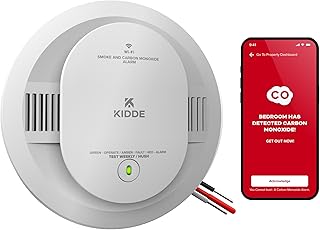
The Kidde KN-COSM-IBA is the second hardwired voice head for wired vacation home rooms, and it pairs with the i12010SCO to cover the rooms where a spoken warning matters more than a phone link on the unit itself. The maker lists an ionization smoke sensor and an electrochemical carbon monoxide sensor, hardwired 120 volt AC power with two AA battery backup, and a voice message system that announces Fire or Warning Carbon Monoxide, so anyone in the house hears which hazard fired without walking the halls. The peak level memory recalls carbon monoxide readings at 100 parts per million or higher, the Hush feature quiets a nuisance alarm, and the front-load battery door lets the household swap the AA cells without taking the unit off the ceiling. The hardwired interconnect covers up to 24 Kidde devices, and the maker lists an 85 decibel horn, a 10 year limited warranty, and a UL listing. The AA backup cells are simple to replace when the household visits, which suits a vacation home routine built around seasonal trips, and the wired power keeps the alarm running between visits. The buyer should understand the limit: this unit itself sends no phone alert, so it belongs in a set where the app-connected alarms carry the remote reporting, and an event it detects reaches the phone through the linked alarms.
- Power: hardwired 120V AC with 2 AA battery backup
- Sensors: ionization smoke; electrochemical carbon monoxide
- Voice: voice message system announcing Fire or Warning Carbon Monoxide
- Interconnect: hardwired up to 24 Kidde devices
- Memory: peak level memory for CO at 100 ppm or higher
- Hush: Hush feature for nuisance alarms
- Battery door: front-load battery door
- Horn: 85 dB
- Warranty: 10 years limited
Pros: Voice messages announce the hazard by name; hardwired interconnect links up to 24 Kidde devices; front-load battery door makes AA swaps easy.
Cons: Sends no phone alert of its own, so it needs app-connected alarms in the same set for remote reporting; backup batteries need periodic replacement unlike sealed models.
First Alert Onelink Smoke & CO Alarm Battery (1042136)
The First Alert Onelink Smoke & CO Alarm Battery (1042136) is the battery version of the same Onelink head, and it is the pick for vacation home rooms with no alarm wiring at all. The maker lists photoelectric smoke sensing and electrochemical carbon monoxide sensing, battery power, Wi-Fi, Apple HomeKit, and alerts through the Onelink Home app, with voice alerts naming the hazard type and its location. The battery life is listed at approximately 5 years, which is shorter than a sealed 10 year head but still means years between changes, and the battery form means the alarm mounts anywhere a bracket can go, including a cabin loft, a converted garage bedroom, or a hallway with no junction box. The app reports smoke, carbon monoxide, and low-battery states to the phone, so a dying battery is a phone notification rather than a chirp nobody hears for weeks. The voice alerts give anyone in the house the room and the hazard without a walk-through, and the HomeKit link keeps the alarm with the rest of an Apple household. The trade is the battery itself: the household must remember the replacement date, and the Wi-Fi features need a 2.4 GHz network that reaches the room.
- Power: battery powered; approximately 5-year battery life
- Sensors: photoelectric smoke; electrochemical carbon monoxide
- App: Onelink Home app alerts; Wi-Fi
- Smart home: Apple HomeKit
- Voice: alerts naming type and location
- Horn: 85 dB class alarm
Pros: Battery power fits rooms with no wiring; voice location alerts and phone alerts match the vacation home need; HomeKit link keeps Apple households in one app.
Cons: Battery needs replacement after about 5 years; Wi-Fi must reach the room for remote alerts.
Buying guide
Start with the property, not the product page. A vacation home may have hardwired alarm boxes in the main rooms and nothing at all in the later additions, so walk the house and note which ceilings have a box and which do not before ordering anything. Hardwired heads belong where the wiring already exists, battery heads belong everywhere else, and mixing the two inside one maker family keeps the whole house in one app. Next, check the internet. Remote monitoring only works when the home network is live, so confirm the router stays on between visits, the Wi-Fi reaches the far bedrooms and any detached bunkhouse, and the alarm band matches the network, since many alarms use 2.4 GHz only. A vacation home with a seasonal internet plan or a router on a timer will not deliver alerts when the plan sleeps, and no alarm can fix that. Voice alerts deserve a close look next. The voice should name the hazard type and the room, and the rooms should be named in the app before the first visit ends, because a voice that says only the hazard still leaves a household guessing which end of the house is involved. Interconnect is the fourth check: hardwired interconnect links heads over house wiring, wireless interconnect links them by radio, and the best setups sound every compatible alarm when one fires, so an event in a back bedroom is heard at the front door. Battery strategy is the fifth check and it matters more in a vacation home than anywhere else, because nobody is there to hear a low-battery chirp. Sealed 10 year batteries end the chore for the life of the alarm, replaceable cells need a dated note on the unit and a reminder, and the app should report low battery to the phone so the chirp is never the first warning. App behavior is the sixth check: confirm the app reports smoke, carbon monoxide, and low battery, confirm whether silencing works from the phone, and confirm that the whole property appears in one account, since a vacation home shared by family members should let every owner see the same status. Finally, check the listings and the service life. Makers list UL 217 for smoke and UL 2034 for carbon monoxide, and a combination alarm should list both, with a service life of about 10 years. Write the install date on each unit, share the app account with the people who look after the property, and arrange for a neighbor or a local contact to hold a key, because a phone alert is only useful when someone nearby can act on it.
FAQ
Will these alarms alert my phone while the vacation home sits empty?
Yes, when the network path is live. Wi-Fi alarms send alerts through the maker app over the home network, and the phone receives them anywhere it has data. The local horn still sounds on its own if the network is down, but the remote alert needs a router that stays on and a network the alarm can join. Check the router and the alarm band before leaving the property empty.
Do voice location alerts really name the room?
Most models in this guide list voice alerts that name the hazard type and its location. The Nest Protect speaks the room it was assigned in the app, the SC5 Battery names the hazard type and location, the Onelink models speak from a list of preprogrammed locations, and the two Kidde hardwired heads announce the hazard type by voice and interconnect with the speaking heads. Set the room name for each alarm during setup, and say the name out loud when you place the unit so the voice matches the room it sits in.
Should a vacation home use battery or hardwired alarms?
Use hardwired alarms where the wiring already exists and battery alarms everywhere else. Hardwired heads draw from the house circuit and keep working on backup through a power cut, while battery heads mount anywhere without new wire. Mixing the two inside one maker family keeps the house in one app and lets the alarms interconnect, so the choice is per room rather than per house.
How do I handle low batteries in a home I visit twice a year?
Pick sealed long-life batteries where possible and let the app report battery state to the phone. Sealed 10 year backups end the chore for the life of the alarm, and replaceable cells should carry a dated note on the unit with a calendar reminder. Never rely on hearing a chirp in an empty house; the app notification is the warning that matters.
Can family members all monitor the same vacation home alarms?
Most maker apps allow sharing access with family members so more than one phone receives alerts. Set up the account before the first trip ends, invite the people who look after the property, and confirm each phone receives a low-battery notice as well as an alarm notice. A shared account also helps when the owner is traveling without data.
What happens to remote alerts if the power goes out at the vacation home?
The alarm itself keeps working on its backup battery and the local horn still sounds. Remote alerts depend on the home network, so if the router loses power the phone alert cannot travel until the network returns. A hardwired alarm with a sealed backup covers the sensing side, and a router on backup power or a hub with its own battery covers the reporting side where that matters.
Conclusion
A vacation home needs alarms that speak clearly and report from a distance, and the six models here cover both jobs between them. The Google Nest Protect (2nd Gen) leads on spoken room alerts, the First Alert SC5 Battery covers unwired rooms in the same system, the Kidde i12010SCO and KN-COSM-IBA cover wired rooms with voice warnings and hardwired interconnect, and the Onelink Safe & Sound (1039102) and Onelink Smoke & CO Alarm Battery (1042136) give Apple households hardwired and battery routes to the same voice and app behavior. Match the power source to the wiring in each room, confirm the network stays live between visits, name every room in the app, and share access with the people who look after the property. Then an empty house can still call for help, and the owner can answer from anywhere.
Related guides
More from Amazon
Programs that pair well with the guide above. Offers and eligibility are set by Amazon and may change.
Collect the home and kitchen items you want in one registry that guests can shop from.
Create a wedding registrySet up recurring deliveries of everyday items on eligible products. Terms and savings are set by Amazon.
Explore Subscribe & SaveFree shipping on eligible items, Prime Video and more. Eligible new members can start with a free trial.
Start a Prime free trialAudiobooks and podcasts to listen to on the go. Eligible new members can start with a free trial.
Try Audible freeAs an Amazon Associate we earn from qualifying purchases.
More ways to save on your next project
Programs that pair well with the guide above. Offers and eligibility are set by Amazon and may change.
A free business account with business pricing and bulk-buying tools for work, shop or home office.
Create a business accountFast, free shipping on eligible items, plus Prime Video and more. Eligible new members can start with a free trial.
Start a Prime free trialAudiobooks and podcasts for the commute, the garage or the kitchen. Eligible new members can start with a free trial.
Try Audible freeA dedicated Amazon storefront for low-price finds. Offers and eligibility are set by Amazon.
Browse Amazon HaulAs an Amazon Associate we earn from qualifying purchases. Using these links costs you nothing extra.




Write Your Review
No reviews yet. Be the first to share your experience!