
Key takeaways
- Compare keyless keypad deadbolts with anti-peep random code entry for a side garage door, with weather ratings, code counts, auto-lock timing and battery life.
What's inside
As an Amazon Associate I earn from qualifying purchases. This post may contain affiliate links at no extra cost to you.
Our top picks at a glance
4 products from this guide, in the order reviewed below.


As an Amazon Associate we earn from qualifying purchases. Prices and availability can change.
A side garage entry door is the door most households use and least households watch. It sits in a dim side yard or a shadowed driveway corner, it is opened with arms full of groceries, tools, or sports bags, and it is the door neighbors, delivery drivers, and passersby are most likely to see someone punch a code into. That combination is exactly why the best keyless keypad deadbolts with anti peep random keypad codes for side garage entry doors pair two features that matter more here than on a front door: an anti-peep entry method that hides the real code inside extra random digits or a shuffling keypad layout, and a weather-sealed exterior that can handle the rain, dust, and temperature swings a side door takes without a deep porch roof over it.
Anti-peep designs work in a few distinct ways, and the differences matter for daily use. Some locks let you type random digits before or after the real code, so a watcher sees a long string instead of a short one. Some shuffle the position of the numbers on a touchscreen after every entry, so finger smudges and repeated touch points never map to the same digits. One model in this roundup uses a random two-digit prompt before the code itself. All seven deadbolts below offer one of these methods, all are sold as single-cylinder or key-free deadbolts for standard door prep, and all add the side-door basics: backlit entry for dark yards, auto-lock so the door secures itself after you carry things inside, and a battery setup that survives months of daily trips through the garage.
Quick verdict
For most side garage doors, the Sifely Model O Smart Deadbolt is the strongest all-around pick: its exterior carries the highest weather rating in this group, the anti-peeping password hides the real code inside extra digits, and the code library is large enough for family, sitters, and service visits. The Ultraloq U-Bolt WiFi is the pick when the garage door is also the smart-home door, because built-in WiFi, an anti-peep backlit keypad, and temporary codes come with no bridge to wire. The Lockly Secure Plus PGD728F takes the privacy idea furthest with a touchscreen that shuffles its digits after every use, and its offline access codes suit households whose garage sits at the edge of router range. The Aqara Smart Lock U100 suits Apple households and adds an IP65 outer panel. The TEEHO TE001 Keypad Deadbolt is the simple standalone route with no app at all. The eufy Smart Lock C210 brings built-in WiFi and a scramble password in a narrow housing, and the Kwikset SmartCode 916 is the Z-Wave option with a Grade 2 rating and a random-digit screen at entry.
Comparison table
| Product | Key spec | Best for |
|---|---|---|
| Sifely Model O Smart Deadbolt | IP65 weather-resistant exterior, anti-peeping password, 150+ codes | Exposed side doors in wet climates |
| Ultraloq U-Bolt WiFi (built-in WiFi) | Built-in WiFi, anti-peep backlit keypad, IP65, temporary and one-time codes | Smart-home garages with no bridge |
| Lockly Secure Plus PGD728F | PIN Genie shuffling touchscreen, 33 access codes, 99 fingerprints | Privacy-first entry on a watched door |
| Aqara Smart Lock U100 | Anti-peep password, IP65 outer panel, 75 passwords, Apple Home Key | Apple households and offline one-time codes |
| TEEHO TE001 Keypad Deadbolt | Anti-peeping password, IP54, 20 user codes plus one one-time code | Simple standalone garage entry |
| eufy Smart Lock C210 | Scramble password anti-peep entry, built-in WiFi, 100 passcodes | Narrow doors that need WiFi |
| Kwikset SmartCode 916 | SecureScreen random-digit entry, Z-Wave Plus, 30 user codes, Grade 2 | Hub homes that want a rated lock |
How we chose
Every deadbolt in this list had to clear the same bar, drawn from the keyword itself. First, the lock must be keyless at the keypad: a code, not a key, is the normal way in, although several models keep a key cylinder as a backup. Second, the lock must offer a genuine anti-peep entry method listed by its maker: extra random digits typed around the real code, a shuffling on-screen keypad, a scramble password, or a random-digit prompt before entry. A plain backlit keypad with no code-hiding method did not qualify. Third, the lock had to fit a side garage door in real conditions, so preference went to models with a published weather rating, a backlit keypad or touchscreen for dark side yards, and auto-lock timing that can be set short, because a door used for quick trips to the garage should not sit open while someone unloads a car.
The comparison also weighed code capacity, since a garage side door often serves the whole household plus dog walkers, cleaners, and contractors; battery type and stated battery life, because a side door lock is easy to forget until it stops working; and door fit, using the cross bore, backset, and thickness ranges the maker lists. Where a spec came from a maker page, manual, or retailer listing, that value is what appears in the table and the product sections. Radios were treated as a household choice rather than a ranking: WiFi models report to an app from the lock itself, Z-Wave and Zigbee models need a hub, and the standalone TEEHO works with no radio at all. Security grades are noted where the maker publishes them, since a Grade 2 lock is a reasonable floor for an exterior door that leads straight into the house through the garage.
Sifely Model O Smart Deadbolt
- Entry methods: touchscreen keypad, fingerprint, fob, and physical key
- Anti-peep: anti-peeping password accepts random digits around the real code
- Codes: 150+ codes, including custom, timed, one-time, and recurring types through the app or web portal
- Weather: weather-resistant exterior, IP65 on the maker's comparison line
- Auto-lock: programmable through the app
- Power: 4 AA batteries, up to about 1 year per charge cycle of daily use
- Alerts: low battery alerts through the app
The Sifely Model O fits the side garage door brief unusually well because its weather sealing and its code-hiding feature are both headline specs rather than footnotes. A side door that faces weather without a deep overhang puts rain directly on the touchscreen, and the IP65-rated exterior is built for that exposure. The anti-peeping password means a teenager waiting in the driveway, or a neighbor at the fence line, sees a long string of digits rather than the family code. The code library is deep enough to give the dog walker a timed code, a contractor a one-time code, and each family member a personal code, all managed from the app or a web portal. Fingerprint entry is the fast route when hands are clean, and the fob and key keep the door workable for anyone who does not want to use the pad at all.
Pros: Highest weather rating in this group; anti-peep entry plus fingerprint and fob options; very large code capacity with timed and recurring types
Cons: App or portal setup is needed to use the full code types; battery alerts arrive through the app rather than at the door
Ultraloq U-Bolt WiFi (built-in WiFi)
- Entry methods: anti-peep backlit keypad, physical key override, app
- Anti-peep: keypad accepts extra digits so the real code stays hidden in a longer entry
- Radio: built-in 2.4 GHz WiFi, no bridge or hub required
- Codes: 4-8 digit codes, with temporary and one-time password codes in the U-tec app
- Weather: IP65 weatherproof exterior case in zinc alloy
- Door fit: standard single-cylinder deadbolt prep, adjustable backset
- Power: 4 AA batteries
The built-in WiFi version of the U-Bolt removes the one accessory garage setups often struggle with: a bridge that has to sit within Bluetooth range of a door that may be far from the house's living space. The lock talks to the router on its own, so temporary codes for a house sitter and one-time codes for a delivery can be created from the app without standing at the door. The anti-peep keypad is backlit, which matters on a side door reached after dark, and the keypad accepts extra digits around the real code so the entry string a watcher sees is longer than the code itself. The zinc alloy case and IP65 rating suit an exposed door, and the mechanical key override covers the dead-battery morning. Voice assistant support through Alexa, Google Assistant, and SmartThings rounds out the smart-home side.
Pros: WiFi built in with no bridge to place near the garage; anti-peep backlit keypad; temporary and one-time codes from the app
Cons: No fingerprint reader on this version; WiFi use shortens battery intervals compared with standalone locks
Lockly Secure Plus PGD728F
- Entry methods: PIN Genie touchscreen, fingerprint reader, physical key
- Anti-peep: touchscreen shuffles digit positions after every entry
- Codes: up to 33 access codes; up to 99 fingerprints
- Offline codes: Offline Access Codes work with no internet connection at the lock
- Radio: Bluetooth, with WiFi through an optional hub
- Auto-lock: programmable
- Door fit: 2-1/8 in face hole, 1 in latch hole, doors 1-3/8 to 2 in thick, adjustable backset
- Weather: IPX4 exterior rating
- Power: 4 AA batteries, up to about 10 months; re-keyable 6-pin SC4 cylinder
The Lockly takes a different route to the same goal. Instead of hiding the code inside extra digits, its PIN Genie screen rearranges the numbers after each use, grouping digits so that even the pattern of touches changes every time. Smudge marks on the glass stop meaning anything, and a watcher memorizing positions learns nothing useful. For a garage that sits beyond reliable WiFi, the Offline Access Codes are the practical feature: a code can be issued that works at the lock with no live connection, which suits a detached garage or a house where the router is at the far end of the building. The fingerprint reader holds up to 99 prints, far more than a household needs, and the re-keyable cylinder means the backup key can be matched to other locks in the house by a locksmith.
Pros: Shuffling keypad defeats smudge and position watching; offline codes suit detached garages; large fingerprint capacity
Cons: IPX4 rating is lighter weather protection than the IP65 models here; WiFi needs the optional hub
Aqara Smart Lock U100
- Entry methods: keypad, fingerprint, Apple Home Key, mechanical key, app
- Anti-peep: anti-peep password accepts extra digits around the real code
- Codes: up to 75 passwords, plus locally generated one-time passwords that work offline; 50 fingerprints
- Radio: Zigbee and Bluetooth; a hub is needed for remote features
- Weather: IP65 outer panel
- Auto-lock: built-in gyroscope supports auto-lock on closing
- Door fit: 2-1/8 in door hole, backset 2-3/8 or 2-3/4 in, thickness 35-55 mm
- Power: 4 AA batteries, up to about 8 months; USB-C emergency power backup
The U100 is the pick when the household runs on Apple devices, because Home Key lets a phone or watch present at the panel the same way a transit card works, while the keypad still carries the daily load for family and guests. The anti-peep password hides the real code inside a longer entry, and the one-time passwords are generated locally, so a code for a contractor works even if the home network is down that day. The outer panel's IP65 rating is a strong match for a side door, and the gyroscope-based sensing helps the lock know the door has actually closed before it throws the bolt, which reduces the half-latched states that plague side doors with stiff weatherstripping. The outer panel is about 2.88 in wide, so it fits most garage side doors without crowding the frame.
Pros: Home Key plus fingerprint plus keypad in one lock; offline one-time passwords; IP65 outer panel
Cons: Remote features need an Aqara or compatible hub; battery life is mid-pack for this group
TEEHO TE001 Keypad Deadbolt
- Entry methods: backlit keypad and physical key override; no app or radio
- Anti-peep: anti-peeping password accepts random digits before or after the code
- Codes: 20 user codes of 4-10 digits, plus a one-time code that deletes itself after use
- Auto-lock: 10-99 seconds, adjustable
- Weather: IP54 waterproof rating; working range -22F to 158F
- Power: 4 AA batteries, about 1 year; low battery warning light under 15 percent
The TEEHO TE001 is the deliberately simple entry in this list, and for a side garage door that simplicity is a feature. There is no account, no radio, and nothing to update; codes are set at the keypad, the anti-peeping password hides the real code inside random digits, and the one-time code covers the neighbor who needs to grab a ladder once. The auto-lock window of 10 to 99 seconds is short and practical for a door used in quick trips, and the backlit pad handles the dark side yard. The stated temperature range is wide, which matters for a door on an unheated garage wall. Battery warning comes from a light at the lock rather than a phone, which suits a household that would rather not manage another app.
Pros: No app or network needed at all; anti-peep entry and a self-deleting one-time code; wide temperature range
Cons: Code changes happen at the door, not remotely; 20 codes is the smallest library in this group
eufy Smart Lock C210
- Entry methods: keypad, app, and physical keys (5 included)
- Anti-peep: scramble password lets extra digits surround the real passcode
- Radio: built-in WiFi and Bluetooth, no hub
- Codes: up to 100 passcodes, permanent or temporary
- Auto-lock: 1 to 3 minutes, or off
- Wrong-try protection: keypad resists repeated guessing attempts
- Door fit: 2-1/8 in cross bore, 1 in door hole; exterior 2-9/16 in wide x 5-3/8 in high
- Grade: BHMA Grade 3
- Power: battery about 4 months at 10 uses per day; IPX3 exterior
The C210 suits the side door that is narrow or crowded, since its exterior housing is one of the slimmer WiFi designs here, and it suits the household that wants app control without a hub. The scramble password is eufy's version of anti-peep entry: extra digits can be typed around the real passcode, so the entry a watcher sees does not reveal the code length or content. Temporary passcodes cover guests and sitters, and the auto-lock can be set between one and three minutes for the carry-everything-inside trip. The trade-off is battery: at heavy daily use through a busy garage door, the stated life is the shortest in this group, so this lock fits best where the side door is a secondary entrance rather than the main path into the house, or where swapping batteries a few times a year is no hardship.
Pros: Built-in WiFi with no hub; scramble password anti-peep entry; slim exterior for tight door trim
Cons: Shortest stated battery life in this group; IPX3 is light weather protection for an exposed door
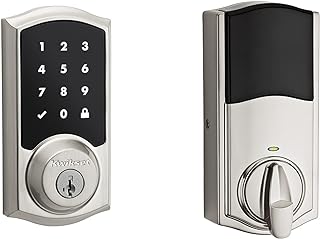
Kwikset SmartCode 916
- Entry methods: touchscreen keypad and SmartKey backup cylinder
- Anti-peep: SecureScreen shows two random digits to press before the code, spreading touch points
- Radio: Z-Wave Plus; a hub is required for remote features
- Codes: 30 user codes of 4-8 digits, plus a MasterCode
- Auto-lock: auto re-lock 30 seconds after opening
- Grade: BHMA Grade 2
- Door fit: 2-1/8 in face hole, 1 in latch hole, backset 2-3/8 or 2-3/4 in, doors 1-3/8 to 2 in thick
- Exterior: 2-13/16 in wide x 5-5/8 in high
- Power: 4 AA batteries; motorized bolt
The SmartCode 916 approaches anti-peep from the smudge angle: before the code, SecureScreen asks for two random digits, so fingerprints spread across the whole pad instead of clustering on the four code digits. On a side door that the same people use at the same times every day, that wear pattern is a real giveaway, and this is the model built to defeat it. The motorized bolt and 30-second auto re-lock suit a door people pass through with their hands full. As a Z-Wave lock it reports into a hub-based smart home rather than an app of its own, which fits households already running SmartThings or a similar hub, and the Grade 2 rating plus SmartKey re-key cylinder make it the most conventionally locksmith-friendly option in this list.
Pros: SecureScreen defeats smudge-pattern reading; Grade 2 rating; SmartKey cylinder can be re-keyed at home
Cons: Remote access needs a Z-Wave hub; no fingerprint reader or one-time code type
Buying guide
Start with exposure. A side garage door under a wide eave lives an easier life than one on a flat wall, so match the weather rating to the wall: IP65 models like the Sifely, the U-Bolt WiFi, and the Aqara U100 belong on exposed doors, while the IPX3 and IPX4 models fit doors with real overhead cover. Next, decide how the anti-peep method should feel at the door. Extra-digit entry, used by Sifely, TEEHO, Aqara, and the U-Bolt WiFi, costs a few extra key presses but works with gloves off and tired eyes. Shuffling touchscreens like the Lockly change the layout itself, which is stronger against watching but slower for anyone who has memorized positions. The Kwikset's random-digit prompt is the lightest touch of the three, adding two presses before the code.
Then count the people. A garage side door serving two adults needs little capacity; a door serving a family, a dog walker, a cleaner, and the occasional contractor needs code types more than raw count: one-time codes for single visits, timed codes for weekly help, and permanent codes for the household. The Sifely and Veise-style libraries are the deepest here, while the TEEHO's 20 codes are enough for most homes precisely because it skips the app layer entirely. Radio choice follows the house: built-in WiFi (U-Bolt WiFi, C210) is simplest, hub radios (916, U100) fold into an existing smart home, and the standalone TEEHO never touches the network. Finally, check the door itself before ordering: cross bore diameter, backset, and thickness ranges are listed for every model above, and a side door with an older 1-1/2 in bore or unusual thickness can narrow the field quickly. Whatever the model, set auto-lock on a side door; it is the door most likely to be left unlatched after a trip with full hands.
FAQ
How does anti-peep entry actually protect a code?
It breaks the link between what a watcher sees and what the code is. Extra-digit systems let random numbers surround the real code, shuffling keypads move the digits after every use, and random-digit prompts spread touch marks across the pad. In each case, an observer, a camera, or a smudge pattern reveals a longer or different entry than the code itself.
Does a side garage door need a weather rating on the lock?
If the door has little or no roof overhang, yes. Wind-driven rain reaches the keypad directly, and dust from a driveway or workshop settles into the housing. A published rating such as IP65 describes a sealed exterior; unrated or lightly rated models belong on doors with real cover above them.
Can these locks work during a power or internet outage?
The keypad runs on batteries, so a mains outage does not stop code entry. WiFi models keep accepting codes stored at the lock when the network drops, and hub models keep local code entry as well. The Aqara U100 and Lockly also support codes designed to work with no connection at the lock at all, which suits detached garages.
What happens when the batteries run out?
Most models warn ahead of time through an app alert or a light at the lock. Several here keep a physical key override, and some offer emergency power contacts or a USB port so a phone battery pack can wake the keypad long enough to enter a code and replace the batteries from inside.
Should a garage side door lock use auto-lock?
For this door, yes. Side doors are used for quick, loaded trips, and they are the doors most often found unlatched later. A short auto-lock window, from about ten seconds on the TEEHO to a few minutes on the eufy, closes that gap without changing how the household moves through the door.
Conclusion
A side garage entry door asks a keypad deadbolt to be discreet, weather-tough, and quick. The seven locks above all hide the real code at entry, but they suit different houses: the Sifely Model O for exposed doors and big code libraries, the Ultraloq U-Bolt WiFi for bridge-free smart control, the Lockly Secure Plus for the strongest anti-watching design, the Aqara U100 for Apple households, the TEEHO TE001 for app-free simplicity, the eufy C210 for slim WiFi entry, and the Kwikset SmartCode 916 for hub homes that value a graded, re-keyable lock. Match the weather rating to the wall, the code types to the people who actually use the door, and the anti-peep style to how the entry feels at night, and the side door stops being the weak point of the house.
Related guides
More from Amazon
Programs that pair well with the guide above. Offers and eligibility are set by Amazon and may change.
Collect the home and kitchen items you want in one registry that guests can shop from.
Create a wedding registrySet up recurring deliveries of everyday items on eligible products. Terms and savings are set by Amazon.
Explore Subscribe & SaveFree shipping on eligible items, Prime Video and more. Eligible new members can start with a free trial.
Start a Prime free trialAudiobooks and podcasts to listen to on the go. Eligible new members can start with a free trial.
Try Audible freeAs an Amazon Associate we earn from qualifying purchases.
More ways to save on your next project
Programs that pair well with the guide above. Offers and eligibility are set by Amazon and may change.
A free business account with business pricing and bulk-buying tools for work, shop or home office.
Create a business accountFast, free shipping on eligible items, plus Prime Video and more. Eligible new members can start with a free trial.
Start a Prime free trialAudiobooks and podcasts for the commute, the garage or the kitchen. Eligible new members can start with a free trial.
Try Audible freeA dedicated Amazon storefront for low-price finds. Offers and eligibility are set by Amazon.
Browse Amazon HaulAs an Amazon Associate we earn from qualifying purchases. Using these links costs you nothing extra.


Write Your Review
No reviews yet. Be the first to share your experience!